If you’ve been following my work for a little while you’ll know that I like to chronicle my fieldwork experiences when possible! I’m just here assuming that everyone is enjoying these, because there are 4 more weeks to go!
I can’t believe that it has already been 4 weeks, and that this experience is already halfway finished! I’m going to take what I’ve learned at the cemetery with me as I continue my burial ground research and work in the future.
Goodness it’s been a busy week, and I’ve learned so much! We took on some cool repairs, cleaned some neat stones, and answered some questions from the public along the way too! It was a pretty good time overall, and I can’t believe we are nearly halfway through the program (thank you to Canada Summer Jobs program to opening your funding up to young people who aren’t going back to school this fall, me and everyone else really appreciate it!!).
There are a few new posts from the last week over at the Woodland Cemetery history blog, about children’s gravestones and our first ‘solo expedition‘ setting a broken gravestone! But it’s time for a review of the entire week, lets get into it!
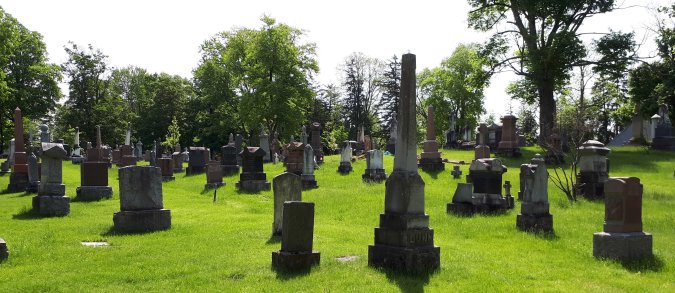
Hello friends, today I’d like to tell you about the first week at my new spring/summer job. I was overjoyed to have recently been hired for a short-term contract at Woodland Cemetery as a Monument Conservator! The job is funded through Canada Summer Jobs program (which isn’t just for students, folks!), so thank you to that wonderful funding that is allowing me to spend eight weeks training to do something I’ve wanted to do for a while…restore and conserve historic burial markers. I feel like I’m living in a burial archaeology dream world right now!
If you want to follow along with the cemetery’s heritage blog, check it out HERE!
Update May 28, 2024: Hi there, if you’ve come to this website from an article denying the atrocities of the Canadian residential school systems, please know that my research does not agree with that idea at all. Through oral history and archaeological evidence, it is extremely obvious that numerous children were harmed, killed, and buried on the properties of residential schools. This post discusses the cultural concept of if a grave can ever be considered ‘no longer there’, and the overwhelming answer is no. So even if you think the decomposition of a body warrants the grave disappearing, the answer is no, no it does not. To believe that white settler graves are in perpetuity, and not Indigenous graves, is frankly racist.
This is a topic I’ve discussed with colleagues on several occasions, and most recently in a really engaging thread on twitter: When is a grave…no longer a grave? If ever, at what point might that happen? There isn’t one definitive answer to this question, and the understanding of a grave, its significance, and longevity are rooted in our backgrounds, cultures, and society. I’ve finally found some time to sit down and write up the results of the discussion, and share some thoughts with you all.
If you’re following my research because you’re extra-interested in death and dying, there is a good chance that you already know about the Order of the Good Death. The Order is an organization founded by funeral director and death positive advocate Caitlin Doughty, and directed by curator Sarah Chavez. It advocates for education and discussion on death and dying, that speaking/working in/researching these subjects is not morbid, and that burials should be moving towards an environmentally conscious set of practices (among many other things!).
The Order hosts this annual, sort of a cross between a conference and a public event, with talks, tours, artists, ad all manner of people who work / study / have an interest in death, called the Death Salon. The last few years I’ve really wanted to attend the event, mostly out of curiosity of what was going on, but they have always been far away from where ever I was living at the time (ie. last year I was in YYT and the Death Salon was in Seattle!).
This year Death Salon is in Boston, MA! The event will be taking place from: September 28th – 30th, 2018, at Mount Auburn Cemetery.
This Saturday I was invited to speak at and participate in a community heritage & folklore event in the town of New Perlican, Newfoundland. New Perlican is located on the eastern coast of the Avalon Peninsula, and has dated back to the 17th-century through records such as the 1675 Berry Census and archaeological evidence of a ‘plantation’ in the area. It is suspected that several of John Guy’s settlers from the 1610 Cupid’s Plantation may have settled in New Perlican in the early 17th century, but there has yet to be any physical evidence of that move identified.
The event I was involved with was a collaboration between the Heritage Foundation of Newfoundland and Labrador, Memorial University of Newfoundland, and Heritage New Perlican, and involved something really that I’m pretty passionate about…burial grounds! Students and community volunteers would join us for the day to learn about the history burial places in this historic town, hear about the town’s history from members of the Heritage group, meet the cemetery cleaning ‘Goats of New Perlican’, and help the community clean up one of their most historic burial spaces. I was there as an additional help supervising the students, to answer questions on burials and gravestones (and have some awesome conversations about headstone preservation with local folks!), and to give a talk about my research as a historic mortuary archaeologist. Also, to map a bunch of gravestones! Continue reading →
This is my first post in about a month, so I thought I’d start by updating you all about what I’ve been up to over the last few weeks!
Basically, I finished my thesis draft in the two weeks after my fieldwork was completed (and the last post was written). Guys, I did it, I wrote my thesis!!
I added in the rest of the fieldwork information, updated references and formatting, and wrote all of the discussion and conclusion sections before sending it over to my supervisor for the rest of the edits. When I got the edits back, I made the changes, got everything prepped, and sent it off as a PDF in it’s final form. My thesis is out for review now, you guys! It’s been in review for a few weeks now, and I’ve got my fingers crossed that it comes back to me soon!
As my friend Steph Halmhofer just did a post about how she put her thesis together, I was inspired to do the same. Everyone has different and interesting ways of approaching a project the size of a masters thesis and it’s always interesting to see their processes! I wanted to share mine, along with any advice from my experience that might be useful for future grad students.
Well here we are, the final week of my Masters excavation! The title of this post may say week 4, but including last year’s dig this would be week 10. Week 10! For a Masters, I believe that is a bit more time spent digging than was necessary for the degree, but in terms of pursuing the questions I was asking… maybe it wasn’t enough time?
We’ll have to wait and see! We got up to quite a bit at Ferryland this week, and I spent part of the week gathering my thoughts about the research, the end of a major part of my project, and what conclusions we can draw from the results.
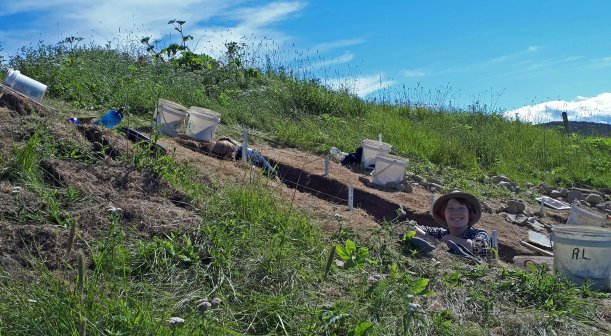
I’m standing up in this photo! The trench got a little deep towards the end of the week. Photo by Ian Petty, 2017.
Here we are, 3/4 weeks complete for the 2017 field season!
Cumulatively, this makes my 9th week excavating at Ferryland in search of the 17th-century burials. Lets go over what we uncovered this passed week, and then I’d like to talk about visitors to public archaeology sites and what we know so far about the burial ground!
It’s time.
The trowels are cleaned*, the boots are dusted off**, and the car is ready and full of excited and bright eyed volunteers***. The fieldwork season has begun!
*it’s never really going to be clean again, is it?
**Same goes for the boots, they are as dusty as ever
*** No one is that bright eyed at 6:30AM!
If you remember from my last post, I had indicated where I was going to be excavating this summer by a large circle on the map. Of course, I’m not going to be digging literally all of the space inside that circle but a few select trenches to get a better idea of what is going on in the subsurface.
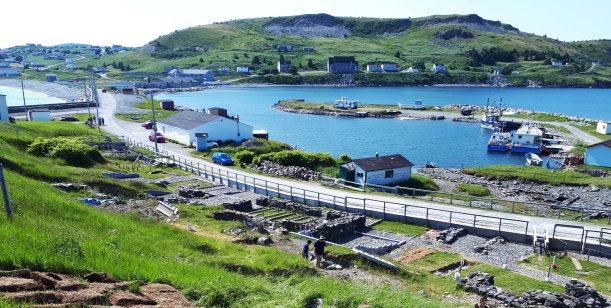
The first trench laid out over the gravel slope. It’s mostly slopewash and debris from above, and parts of the area were previously excavated so the ground lever was actually much higher than it currently appears to be! Photo by author, 2017.





 Spade & the Grave