Spade & the Grave

death and burial through an archaeological lens


3 Comments

Burial by the Sea: Historical Burial Ground excavation in Newfoundland

From 2016 – 2017, I was involved in a project to excavate a settler burial ground in Foxtrap, Newfoundland. The excavation was run by Dr. Vaughan Grimes and Maria Lear of the Archaeology Department at Memorial University of Newfoundland, and is under an active archaeological permit through the Provincial Archaeology Office (PAO) of the Government of Newfoundland and Labrador throughout post-excavation analysis. A handful of graduate students, including myself, made up the rest of the field crew.

Based on local knowledge and the PAO investigation of the site in 2006, we were already aware that there was likely a burial ground at this location, based on the several erect and laying markers and fragments of gravestone with inscribed text. While no single record appears to exist for who was buried at this site, and it only had one gravestone with inscriptions on it, the identities of most of the individuals interred there will likely remain a mystery (and that one gravestone was broken and out of situ so we have no idea whose grave it belongs to). Plans are already afoot to re-inter the remains nearby once they have been cleaned and studied.

I am honoured to have been part of the team exhuming this site, as it was the first full historical settler burial ground to be excavated in the province, and so much about early populations could (and will) be learned from those who were buried there.
Continue reading →


Leave a comment

The Frankenstein Chronicles: Exploring themes of Mortality in the C19th

As my own adventure into archaeology..or death and the media, I thought it would be fun to blog along with Netflix’s new show ‘The Frankenstein Chronicles’. 50% of this desire is based on the subject matter and a few of the lines regarding ‘beating death’ in the trailer, and the other 50% are because it stars Sean Bean and his heavy northern accent. Lets go! There will be spoilers!

Continue reading →


12 Comments

Winter Corpses: What to do with Dead Bodies in colonial Canada

Dead_House__from_North_East_Nain_Labrador

Dead house in Nain, Labrador (Jarvis 1995. From the Memorial University of Newfoundland-Intangible Cultural Heritage Inventory

Welcome back, dear readers, to another installment of a blog about burial practices and archaeology! Today I’d like to talk about something that is close to by heart (as the result of arguing about it during my thesis): What did people do with their dead bodies during the winter, in colonial Canada?! Well, there are a few options to discuss but the short answer is…

Keep them.
Continue reading →


5 Comments

Sailor, War Prisoner, Settler: John Harris

This post is a bit of a departure from my normal themes, but there will be a gravestone or two, never fear! I spent a lot of last weekend working on a submission for the publication ACORN put out by the ‘Architecture Conservancy Ontario’, with my brother, who is nearly finished his undergraduate degree in architecture at the University of Waterloo (shout-out to my cool brother!). We wrote about the importance of conservation and reuse at the Harris & Co. Woolen Mill in the Rockwood Conservation Area in Rockwood, Ontario (Township of Guelph/Eramosa), and its been a lot of fun to work on a project together!

While doing research for the paper, we were reading a document that our aunt has had for a while: Transcriptions of John Harris’ Diary from 1811 – 1820. Reading historic documents is an excellent way to gain insight into not only a person’s life and day-to-day activities, but also to get a better understanding of who that person was in their life. John’s diary was mostly records of what he did, with some personal thought and strife added in there, but it is where a lot of these events occurred that I remain amazed that he managed to record any of it at all. Lets delve in, shall we?
Continue reading →


3 Comments

New Perlican: Blank Gravestones & Mapping

22627581_10155298965582983_2012522379_n

Myself, mapping away on our plan of St. Mark’s! Photo by Ian Petty

Yesterday I headed back to New Perlican with Ian Petty (2nd year MA student in Archaeology at MUN) to meet up with Dr. Shannon Lewis-Simpson from Memorial University of Newfoundland in order to continue with the surveying of the St. Mark’s historic burial ground. The weather was not ideal and I was hard-pressed to remember if we’d used a plastic drafting film or normal paper to draw the map on in the first place, so with rain in the forecast our fingers were crossed!

I wanted to go get as much of the burial ground mapped as possible before the rain set in…and before I had to start my new job! There will be more details on that major life change later though, this post is still about the burial ground in New Perlican.
Continue reading →


8 Comments

Community Mortuary Archaeology & Folklore – New Perlican, Newfoundland

This Saturday I was invited to speak at and participate in a community heritage & folklore event in the town of New Perlican, Newfoundland. New Perlican is located on the eastern coast of the Avalon Peninsula, and has dated back to the 17th-century through records such as the 1675 Berry Census and archaeological evidence of a ‘plantation’ in the area. It is suspected that several of John Guy’s settlers from the 1610 Cupid’s Plantation may have settled in New Perlican in the early 17th century, but there has yet to be any physical evidence of that move identified.

The event I was involved with was a collaboration between the Heritage Foundation of Newfoundland and Labrador, Memorial University of Newfoundland, and Heritage New Perlican, and involved something really that I’m pretty passionate about…burial grounds! Students and community volunteers would join us for the day to learn about the history burial places in this historic town, hear about the town’s history from members of the Heritage group, meet the cemetery cleaning ‘Goats of New Perlican’, and help the community clean up one of their most historic burial spaces. I was there as an additional help supervising the students, to answer questions on burials and gravestones (and have some awesome conversations about headstone preservation with local folks!), and to give a talk about my research as a historic mortuary archaeologist. Also, to map a bunch of gravestones!
Sept30_1 Continue reading →


6 Comments

‘These are grave terms’ – terminology in historic mortuary archaeology (for colonial North America)

First of all, I’d like to start by acknowledging that my last post was two weeks ago and my reason for not posting more frequently is: a) the job hunt, and b) I have been madly finishing a paper and my thesis..which was submitted yesterday officially! Yay!

I thought it would be nice, and relevant to do a post today discussing terminology for burial spaces and monuments. The terms I’d like to go over have some history to them of course, but like anything, they can take on different meaning depending on who is using them and where they are in the world. For the purposes of this discussion, I’m looking exclusively at colonial North America because that is my current study area, and dealing with basically only British/Irish, Christian (Catholic/Anglican/Quaker/Puritan,etc) burial spaces at this point. (I’m looking forward to seeing how these change as I go back in time a bit for PhD research in a few years)

terms3

Hartford, CT burial ground, facing the later-added church. Photo by author, 2015

Continue reading →


5 Comments

Inscribed Letters & Protective Marks – The Case of the W

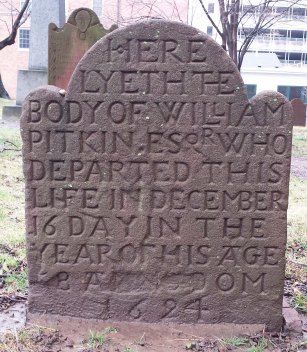
W4

Pitkin headstone, 1694 (vandalized), Hartford, CT. Note the VV style W. Photo by author, 2016.

Inscribed text is something that I’ve been passionate about studying ever since my first field school as a little baby undergraduate student. Recording gravestones in a rainy July in Ireland, I pieced together fragments of words that no one had read out loud for decades and recorded them onto my forms, creating a record once more for a nearly-erased gravestone. In doing so, I became fascinated by the way that letter forms evolved and were adapted through history, from inscribed letters in stone, to calligraphy, to typeface for printing presses which has become our digital text today!

Several years ago I conducted a project funded by the P.U.R.E Grants through the University of Calgary to explore the way in which letters erode from the face of gravestones, during which I spent a lot of time sitting in the rain with my waterproof notebooks, drawing letters using a hash-line system I developed to represent different stages of erosion. It’s a whole thing. The paper which resulted from this project is currently in peer-review, and I wanted discuss in part, one of the aspects of the project in conjunction with my recent interest in ritual protection marks. In this case, the letter W, and their use in inscriptions and as protective markings.

Continue reading →


1 Comment

Podcast alert: Go Dig a Hole!

blog2_1

Not too long ago (but while I was on holiday and didn’t have time to post about it) I was invited by Christopher Sims to appear on his awesome archaeology podcast ‘Go Dig a Hole!’.

We chatted about my work on burial landscapes, this blog, and the use of social media in archaeology and heritage, which I obviously will champion until the very end! I had a load of fun with the interview, and if you are interested in listening to the podcast please click:

—–> HERE (audio) <—-> or HERE (for the blog post & audio) <——

I’ve really been enjoying getting involved in different forms of media, with podcasts and radio interviews happening lately, as I feel like it’s a good way to ease into giving even more talks in the future. Throughout my academic career I’ve always been pretty nervous about public speaking to the point that I dropped a class in my undergrad to avoid giving a short presentation every class as the syllabus suggested we might have to do. That’s not a good way of growing as a researcher though, if you want your research to be disseminated in as many ways as possible!

When I got to grad school, I decided that no matter how scary it might be, I needed to push myself to speak in public more, whether that be breaking into a seminar conversation, accepting a guest lecture request, volunteering to talk at a heritage site AGM, or giving my first overseas’ conference presentation. All that *facing your Fears* stuff is working, you guys! I did all those things in the past year or so! Podcasts and the radio are part of it, so thank you to everyone who has listened to me go on about burials in whatever form of media you found me through, it’s been such a journey on social media recently and its been great!


1 Comment

Robyn’s Guide to Master’s Thesis Writing, or, How I Scheduled Everything.

20170731_095059

The victorious, tired grad student!

This is my first post in about a month, so I thought I’d start by updating you all about what I’ve been up to over the last few weeks!

Basically, I finished my thesis draft in the two weeks after my fieldwork was completed (and the last post was written). Guys, I did it, I wrote my thesis!!

I added in the rest of the fieldwork information, updated references and formatting, and wrote all of the discussion and conclusion sections before sending it over to my supervisor for the rest of the edits. When I got the edits back, I made the changes, got everything prepped, and sent it off as a PDF in it’s final form. My thesis is out for review now, you guys! It’s been in review for a few weeks now, and I’ve got my fingers crossed that it comes back to me soon!

As my friend Steph Halmhofer just did a post about how she put her thesis together, I was inspired to do the same. Everyone has different and interesting ways of approaching a project the size of a masters thesis and it’s always interesting to see their processes! I wanted to share mine, along with any advice from my experience that might be useful for future grad students.

Continue reading →