Spade & the Grave

death and burial through an archaeological lens


2 Comments

Book Launch: Burial & Death in Colonial North America

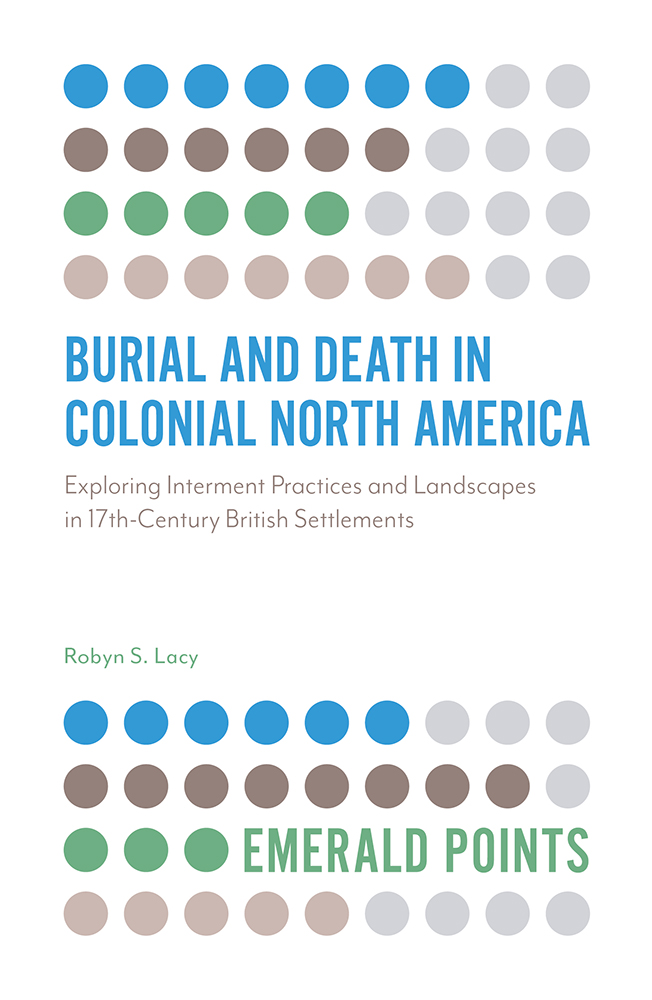
I’m so pleased to announce the publication of my first book, ‘Burial and Death in Colonial North America: Exploring Interment Practices and Landscapes in 17th-Century British Settlements‘, published by Emerald Published Ltd!

This book has been in the works technically since 2018, but really several years prior, as it incorporates a lot of my Master’s research! It is also filled with a bunch of really cool other stuff about 17th-century burial landscapes and practices, coffins styles, soil stains (well, I think they’re cool), and protective symbols on graves!

Published in Emerald’s ‘Emerald Points’ series, the book is available for pre-order through the Emerald Publishing website, Amazon, and The Book Depository, as both an ebook and a print book (pre-orders are open on some sites). It will be available as an ebook through multiple carriers soon!

If you are interested in downloading the flyer, CLICK HERE.

Thank you to everyone who helped me through this process, my family, friends, editors, twitter, etc! My two goals in life as a child were to become an archaeologist and to publish books. I always assumed that my first published book would be a novel, but I think academic books also check that box off (don’t worry, novel(s) are in the works)! The archaeology part has been covered for a while!

Citation:

Lacy, Robyn S. 2020. Burial and Death in Colonial North America: Exploring Interment Practices and Landscapes in 17th-Century British Settlement. Emerald Publishing Ltd.: Bingley, UK.


Leave a comment

In Conversation: Questions in Mortuary Archaeology

20190625_092601

Working at Woodland Cemetery to repair a complex marble monument (photo by Brienna French 2019)

Yesterday I had a the pleasure of answering a few questions about my research and work from Dr. Shawn Graham of Carlton University (@electricarchaeo on twitter), for his fall course, ‘Digital History and Digital Archaeology’. Now, I don’t really do digital archaeology, but the questions could be answered focusing on anyone’s specialities. I wanted to share the discussion with all of you! (these answers aren’t work-for-word my short interview answers, but pretty close!)

1. Who are you and what are you currently working on?
Hi everyone! My name is Robyn Lacy, and I’m a historical archaeologist. I work for a cultural resource management (CRM) firm in Ontario, where I am an archaeological, cultural heritage, and social media technician. I’ve been doing this job since early winter, but I’ll be starting my PhD in Historic Archaeology at Memorial University of Newfoundland (remotely at first)! I’m also finishing up my first book which is based on my Master’s research in 17th-century British burial landscapes in North America, and starting research on my second book as well. Exciting stuff!

Continue reading →


Leave a comment

What’s in my (Field) Bag?

Today’s post isn’t exactly death-related, but I wanted to take a sec and share what I carry with me into the field. If you are starting out in archaeology or are heading into your first field season in cultural resource management (CRM) or a field school, I hope this post can be a little helpful to you!

I’ve been doing fieldwork on and off since 2011, in Ireland, the Isle of Man, the UK, and Canada (BC, NL, and ON), and these items are things that I always like to have on me, and items that have stood the test of time being dragged around the mountains, overseas, corn fields, and most recently the blistering heat and random rain storms of Ontario! Lets dive in and take a look at what’s in my (field) bag!

20200729_182656 (1)

My field bag & gear I always carry! 

Continue reading →


Leave a comment

Book Review: Changing Landscapes in Urban British Churchyards.

51w-q920EFL

This post is a formal review of the newly published ‘Changing Landscapes in Urban British Churchyards’ by S.E. Thornbush and Mary J. Thornbush (2020), for Bentham Science Publishers, Singapore.

While academic and public interest books on burial grounds are often published, they tend to only consider the gravestones, and not the spatiality of the burial ground. This book by Sylvia E. Thornbush and Mary J. Thornbush examines gravestones within multiple east coast cities in England and Scotland, as well as the sites’ locality. However, for a text that is titled ‘changing landscapes’, I was hoping for more of a study of the sites as landscapes and spaces over the gravestones.

The sites focused on in this book are situated close to the coast, as to examine the effects of coastal erosion on headstone legibility and weathering rates, although other sites, such as York, were also selected based on the quantity of gravestones available for examination. The goal of the research was to compare the classic Dethlefsen & Deetz 1966 iconographic study (reprinted: Deetz 1977) to trends in the UK. The authors note that there are linguistic features which marked ‘Puritanism’ used on epitaphs, as well as within the iconography. However the iconography, in particular the ‘Death’s Head’ is still wrongly associated with specifically Puritan beliefs. The main goal of the study is stated as looking for differences in style of headstones in England and Scotland from the C17th-C19th after the Protestant Reformation, and how were they distinct from those found in C19th New England.

Continue reading →


Leave a comment

An Introduction of Archaeological Illustration: Small Finds Workshop

Picture 1

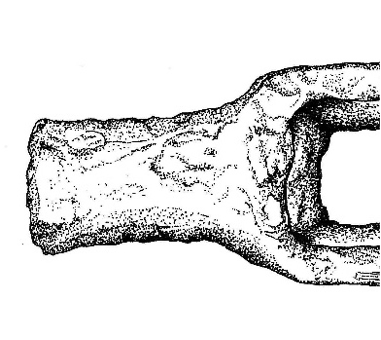
Portion of metal axe head (Lacy 2017)

This Friday, June 19th (Juneteenth), I taught an online workshop for the Newfoundland and Labrador Archaeology Society (NLAS). In case you missed the workshop or wanted a refresher after we wrapped up, I’ve turned the step-by-step drawing tips in a blog post. I presented the workshop from the occupied traditional territories of the Anishinaabek, Haudenosaunee, Lūnaapéewak, and Attawandaron peoples, under Treaty 6.

This post is a departure from my typical death and burial posts, The following post uses illustrations I drew specifically for the workshop, and I hope you find it helpful! In the field, I use my drawing skills in a number of ways, and it is always a skill worth investing time into. Please let me know if you have any questions.

Continue reading →


1 Comment

Death & Monumentation through Built Heritage

In my last post, I mentioned the ‘London Marble and Granite Company Limited’, which was originally founded by J.R. Peel, a renowned artist and gravestone carver. Today I’d like to talk a little more about about Peel, his shop, and the idea of death within the built landscape and our cultural heritage.

If you haven’t heard of John Robert Peel before, let us review. An artist, Peel was born in England in 1830, and married Amelia Margaret Hall in 1849. The couple relocated to London, Ontario in 1852. Peel became an art teacher, highly involved in the growing city’s art scene, and eventually carved gravestones! John and Amelia had several children, including Paul Peel and Mildred Peel, both noted Canadian artists.

20200307_131158 (1)

Continue reading →


3 Comments

Curious Canadian Cemeteries: Kilworth (Baker) Cemetery, Delaware Township, Middlesex County, ON

Today’s Curious Canadian Cemeteries is brought to you by being trapped inside during Week 3-to-4 of work-from-home-quarantine. What an interesting time we are living in…? Let me help distract you for a moment with this post about a small burial ground near London, ON, the Kilworth (Baker) Cemetery, Delaware Township, Middlesex County, Ontario.

I came across this site while heading out to a sugar bush (several weeks ago, when we were still able to go outside and do things! #socialdistancing). Despite living in Ontario since 2017, I hadn’t managed to go to a sugar bush before, so that in itself was exciting! Of course, I was more than happy to add a little burial ground visit into the trip when we spotted this one along the side of the road.

20200307_130921 (1)

View looking east from the entryway (photo by author 2020)

Continue reading →


Leave a comment

Curious Canadian Cemeteries: Ellis Chapel, Puslinch Township, Wellington County, ON

It’s been a while for this series, hasn’t it? Today we will be exploring a historically very rural site, the Ellis Chapel, which is located in Puslinch Township, Wellington County, Ontario. The chapel can be accessed from the parking lot of the Cambridge On Route off the 401, west-bound, or from Ellis Road. The address of the site is: 6705 Ellis Rd, Cambridge, ON, N3C 2V4.

While this site is mostly known for its historic, coursed masonry chapel, constructed in 1861, the grounds include a small graveyard. Let’s take a closer look!

20200313_172930

Rear of the chapel, as seen from the south (photo by author 2020).

Continue reading →


2 Comments

Return to the Rock: PhD Research Outline!

Hi friends, it’s been too long since I’ve written a post! Hope everyone is washing their hands and staying out of large gatherings during this ol’ covid-19 outbreak we’re all dealing with. Also you don’t need that much tp, friends. Ok, since coming back from Boston in January, I’ve started a new position with a local CRM firm, TMHC, as their archaeological, cultural heritage, and social media technician! It’s been amazing so far, and I can’t wait for the field season to start! If you follow me on social media though (or, you know, read the title of this post) then you’ll know I’ve had another big thing happen in the last few months…I’ve been accepted into Memorial University of Newfoundland’s PhD program for Archaeology, which starts Sept 2020!

Yay!!

I decided I wanted to do a PhD because my favourite part of archaeology besides the excavation is the research & the writing. I really love writing up results, explaining the thoughts behind doing specific things, digging into the backgrounds, and learning about how people operated in the past. Since finishing my MA in 2017, I’ve been continuing my research and writing on my own time, published 2 papers, have been working on a manuscript, and have another project up my sleeves, along with giving some public talks and stuff….and that takes a lot of time! What better way to balance all this free work than diving back into a PhD where all this research I’m already doing can move to the forefront of my priorities? I’m really excited to focus more of my energy on this research.

20180713_134914

The author with a cemetery sign, 2018.

Continue reading →


1 Comment

Holiday (/Conference) Diaries: SHA 2020 Boston, MA

Fresh off the airplane from Boston, and back to the blog! This past week I had the pleasure of attending the Society for Historical Archaeology’s (SHA) 2020 Annual Meeting in Boston, MA. It was my first SHA conference, and definitely one of the largest conferences I’ve had the change to attend so far, and it was such a wonderful experience! Of course, we did some touristing while we were in town…and most of the talks I attended had everything to do with colonial burials & settlements!

20200107_133911

Back Bay, Boston MA

Continue reading →