Hello friends! Recently, I recorded a podcast episode for The Arch & Anth Podcast, with Dr. Michael Rivera. We chatted about my research in death and burial, work in CRM archaeology, and gravestone conservation. It was lovely, and the episode is out now!
You can listen to the episode by clicking on the link below, or by looking for the podcast on Spotify, Stitcher, iTunes, etc.
This post is a digital summary version of a paper I’d written for a course during my masters, and later expanded on to present at the Transmortality conference in Luxembourg in 2017. I’m choosing to turn these ideas into a blog post, because I think it’s a rather interesting topic and I’d love to have a discussion with all of you about it! So let’s dive it, shall we?
By investigation the relationship between burial spaces and their communities, we can gain insight into the personal relationship between people and death. This post will explore interaction with burial spaces and the influence of these spaces on movement throughout history, from the 17th to the 21st centuries. I looked at Boston, MA and Guilford, CT as my case studies, through historic and modern accounts of being in the burial grounds, examining the multi-purpose use of many of these early Puritan sites.
The Guilford Green, Guilford, CT (Photo by author 2016).
You might have seen in one of my more recent posts that I was involved in the Doors Open event in London, answering questions and giving tours of two burial grounds that I worked at over the past years: Woodland Cemetery and the Brick Street Cemetery. I’m not going to reiterate that post (though it is linked above if you wanted to check it out), but in reminiscing that even earlier this week, I found myself thinking a bit more about public archaeology of death and burial and how we interpret these topics to the public.
First thing in January I will be presenting a poster at the Society for Historical Archaeology conference with my friend Sarah that follows a little in line with this topic. Our poster is titled “In Memoriam: Challenges in Historic Burial Ground Conservation” and some of these challenges arise when information about conservation and burial grounds are adequately communicated to the public. I’ll be posting more about the poster in Jan, but it bleeds into today’s topic a little!
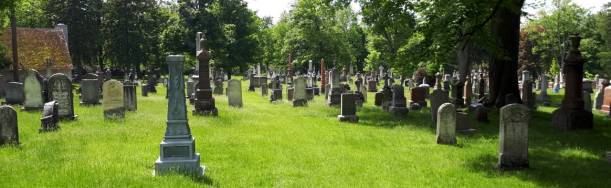
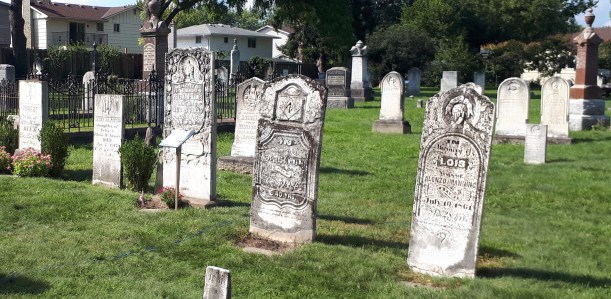
A view of Woodland Cemetery, Section R, facing west.
Some of you who are active in the archaeology twittersphere may have witnessed the incident that occurred last night / this morning / semi-ongoing. As it relates to burial archaeology specifically, I feel the need to expand on my original retweet.
Here is a breakdown: An archaeologist with a huge public platform, who is very well known for her branding of the term ‘space archaeology’ (this, in itself, it a whole other story), posted a request to her followers to help fund her latest archaeological investigations in Egypt, her primary study area.
If you follow my social media, you might have gathered a few things recently. Firstly, I just got back from a lovely holiday in Scotland where I explored the morbid and macabre as one such as myself is wont to do, and secondly, I got engaged! So that is all very exciting, but because this is a death blog, I’m going to focus on the former for now.
The majority of my trip was based in the city of Edinburgh. The city is famous for being the home of the Royal Family’s Palace of Holyroodhouse, Edinburgh Castle and the Military Tattoo, and of course…Burke and Hare.
Edinburgh & the Firth of Forth, from Calton Hill (photo by author 2019)
Hello again, fellow death & burial enthusiasts! My goal with these posts is to share my love of a type of structure that isn’t widely written about (clearly my goal is to change that), and inform you all about a burial practice that was reserved for the colder parts of the world…Canada, parts of the USA, the UK, etc. My research on the practice has been restricted to North America and the British Isles thus far, though it is also clear through readings that winter body storage had to happen in many other places as well (ie. Iceland). I can’t wait to dive in further!
Today I wanted to talk about why some of these structures are octagonal in Ontario, as opposed to a standard rectangular or subterranean structures. There might be a method to this madness!
The 15th-century octagonal font at Stoke-by-Nayland, Suffolk, UK. (Image by Michael Garlick 2018)
This past weekend was Doors Open London, which is a weekend where historic sites and buildings open their doors to the public, free of charge to allow everyone to see places that they might not otherwise have a chance to experience. It’s an awesome time to be a tourist in your own town, and quite a lot of cities participate in the ‘Doors Open’ concept, all throughout the year! See if your city does…and if not, maybe encourage them to??
I had the pleasure of volunteering on Saturday at two sites: Brick Street Cemetery and Woodland Cemetery, both of which you’ll have heard oodles about already if you’ve been following my blog. There were some pretty cool things going on, and it was an awesome opportunity to participate in some public outreach and public archaeology!
It’s a common theme throughout history, that women’s stories are swept under the rug, intentionally or not, to make way for the stories of history’s great men. Of course, with cis women, trans, queer, and otherwise non-gender-conforming individuals being present throughout history, the tales of ‘men’ are only a small fraction of the whole story.
Gravestones from the 19th century have a common formula when it comes to remembering women, and that is by labelling them as wife of… and often not providing any additional information about them. Often nothing much is recorded throughout history about them either, making it even more difficult to find anything else out other than who they married. Today I’d like to talk about three young women who are buried at Brick Street Cemetery, and were early settlers in the area in the mid-19th century: Phoebe McNames, Silvany Tunks, & Hannah Caldwell.
It is my greatest joy to share the identification of the 8th identified Octagonal Dead House in Ontario with you all! This structure was located and relayed to me by Adam Montgomery, PhD, who runs @CaCemeteryHist on twitter and the Canadian Cemeteries History website. I was so excited to hear about this site, and to add it to my growing database of the structures.
If you’ve missed my previous posts on this topic, please find them HERE and HERE. Those posts cover the use of dead houses historically, and have images of the other structures! They range from ornate stone to simple brick, and are something to behold.
Today I’d like to write a short post to tell you all about a few amazing instances of the pursuit of a ‘proper’ burial against all odds. Before starting, I would like to state that this is a proper burial through the lens of primarily white settler communities in the 19th and 20th centuries in what is now Canada. Thanks!
What denotes a good burial? It can be defined by a person’s social status, their religion, their personal beliefs and choices, fads of the time, and a number of other things. A proper, good burial in the medieval period included being close to the altar, in ancient Egypt it meant having belongings with you to help in the afterlife, for southern USA enslaved families it meant being able to bury their dead in peace on their own terms. For settler communities in Newfoundland and mainland Canada, it meant being able to follow their traditional burial practices of interment, regardless of the conditions.
A buck at Woodland Cemetery (photo by author 2019)