We’re heading back west for this week’s Curious Canadian Cemeteries installment (ok I know its been a few weeks, but there is work to do and papers to write!), lets take a look at the famous (and rather large) Union Cemetery in Calgary, Alberta.
Funeral procession at Union Cemetery, Calgary, 1911. (Glenbow Archives, NA-2315-6)
I’ve been living in Ontario for a few months now, but in just a couple of days it will finally be time to complete the second half of the move (i.e. moving the rest of the stuff, the car, and my partner). It’s crazy to think that we are going to be leaving the island so soon, but we will definitely be back for loads of visits.
I thought what better way to kick off part 2 of our move…and part 2 of the Curious Canadian Cemeteries Series, than with a site in St. John’s that I have visited on multiple occasions, and even wrote a paper on: The Belvedere Roman Catholic Cemetery.
Yes, that is a tiny out-of-context stone sheep relaxing in the grass.
Hello there, death and burial aficionados! I come to you today with a new series that I’m starting on Spade & the Grave called ‘Curious Canadian Cemeteries’ (cemeteries because it works for the 3 C’s, not because I totally agree with the term for all sites). Recently, I’ve noticed that a lot of publications that talk about burial sites around the world tend to gloss over Canadian sites, and I’d love to bring a few of the amazing burial grounds across the country into a bit of the spotlight! So if you have any interesting suggestions, I’d love to hear them! I’m going to try to make this either a weekly or bi-weekly feature on the blog, amidst other posts as I think of them.
Burial grounds, graveyards, cemeteries…whatever the terminology is for the site, every one holds a unique history and place within the landscape. While large, famous sites like Mount Auburn Cemetery or the Granary in Boston see visitors every day due to their publicity (and amazing monuments), there are hundreds of smaller burial grounds across North America and the world, that have just as rich of a back story, but might not be quite so obvious to the burial ground visitor on the go. Sites like these were meant to be visited, cared for, and enjoyed. They were created for the living just as much as the dead, and visiting historical burial grounds isn’t morbid. So without further adieu, lets virtually visit some unique burial grounds, from across Canada!
For my first post in the series, I wanted to feature a graveyard from one of my childhood homes, and the place that I lived in for the longest:
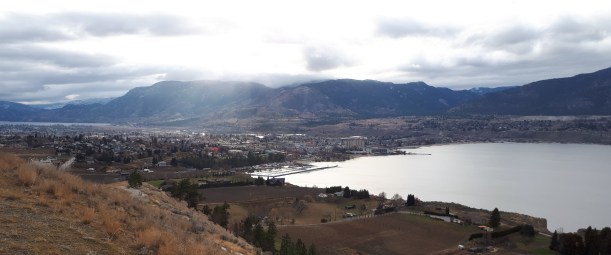
Penticton, British Columbia.
Penticton, BC, viewed from Munson Mountain (photo by author 2018)
From 2016 – 2017, I was involved in a project to excavate a settler burial ground in Foxtrap, Newfoundland. The excavation was run by Dr. Vaughan Grimes and Maria Lear of the Archaeology Department at Memorial University of Newfoundland, and is under an active archaeological permit through the Provincial Archaeology Office (PAO) of the Government of Newfoundland and Labrador throughout post-excavation analysis. A handful of graduate students, including myself, made up the rest of the field crew.
Based on local knowledge and the PAO investigation of the site in 2006, we were already aware that there was likely a burial ground at this location, based on the several erect and laying markers and fragments of gravestone with inscribed text. While no single record appears to exist for who was buried at this site, and it only had one gravestone with inscriptions on it, the identities of most of the individuals interred there will likely remain a mystery (and that one gravestone was broken and out of situ so we have no idea whose grave it belongs to). Plans are already afoot to re-inter the remains nearby once they have been cleaned and studied.
I am honoured to have been part of the team exhuming this site, as it was the first full historical settler burial ground to be excavated in the province, and so much about early populations could (and will) be learned from those who were buried there. Continue reading →
As my own adventure into archaeology..or death and the media, I thought it would be fun to blog along with Netflix’s new show ‘The Frankenstein Chronicles’. 50% of this desire is based on the subject matter and a few of the lines regarding ‘beating death’ in the trailer, and the other 50% are because it stars Sean Bean and his heavy northern accent. Lets go! There will be spoilers!
Dead house in Nain, Labrador (Jarvis 1995. From the Memorial University of Newfoundland-Intangible Cultural Heritage Inventory
Welcome back, dear readers, to another installment of a blog about burial practices and archaeology! Today I’d like to talk about something that is close to by heart (as the result of arguing about it during my thesis): What did people do with their dead bodies during the winter, in colonial Canada?! Well, there are a few options to discuss but the short answer is…
This post is a bit of a departure from my normal themes, but there will be a gravestone or two, never fear! I spent a lot of last weekend working on a submission for the publication ACORN put out by the ‘Architecture Conservancy Ontario’, with my brother, who is nearly finished his undergraduate degree in architecture at the University of Waterloo (shout-out to my cool brother!). We wrote about the importance of conservation and reuse at the Harris & Co. Woolen Mill in the Rockwood Conservation Area in Rockwood, Ontario (Township of Guelph/Eramosa), and its been a lot of fun to work on a project together!
While doing research for the paper, we were reading a document that our aunt has had for a while: Transcriptions of John Harris’ Diary from 1811 – 1820. Reading historic documents is an excellent way to gain insight into not only a person’s life and day-to-day activities, but also to get a better understanding of who that person was in their life. John’s diary was mostly records of what he did, with some personal thought and strife added in there, but it is where a lot of these events occurred that I remain amazed that he managed to record any of it at all. Lets delve in, shall we? Continue reading →
I have a quick announcment for anyone interested in my work with the Ferryland gravestones! A while ago I wrote a paper on the analysis of the gravestones with Drs. Barry Gaulton and Stephen Piercey, of Memorial University of Newfoundland.
The paper is being published in the North Atlantic Archaeology Journal, Volume 5, and I just got the pdf proof of the formatting. This is really exciting, as my first published academic paper, and also my first published piece of the script development work I did the fieldwork for waaaay back in 2012! (That paper is in the works, never fear)
If you are interested, here is the abstract, and I’ll update this post when I know the publication date of the journal.
Complex monument in North Wales (photo by author, 2012)
Hello readers, many of you are being directed here via the Heritage NL gravestone conservation tips and/or by Dale Jarvis! I originally wrote this post in 2017, and have since moved back to Newfoundland and have started my PhD in Archaeology (fall 2020). I have been working in heritage for nearly a decade, and specialise in burial ground archaeology and gravestone conservation. Last summer (2019) I had the pleasure of working full time as a gravestone conservator at Woodland Cemetery in the City of London, Ontario, and have since worked with Brick Street Cemetery in London, and on some other conservation projects as a heritage consultant in the Maritimes. I have given talks on gravestone preservation best practices to a number of organisations over the last year or two, and would have happy to answer any questions you many have about a site in your area. Please contact me through my website, or at blackcatpreservation (at) gmail.com. As an archaeologist with experience and graduate degrees in Newfoundland and Labrador, I am able to be a permit holder for archaeological projects such as burial ground projects.
The purpose of this post if to inform volunteers and communities groups who are invested in the care of their local historic burial sites of the current best practices in gravestone and burial site conservation. We all know that burial sites are a vital historic resource for learning about our communities, as well as the resting places of our families and friends, and they deserve to be cared for and conserved as best we can. As an archaeologist and burial ground specialist, I hope to help you do that, and it is my goal to make the conservation techniques for ‘Do No Harm’ care as widely available as possible.
Note: I am speaking only of the conservation and archaeology of settler burial grounds, as a settler in Canada. Work with Indigenous communities in their burial spaces is another topic entirely and should never be undertaken without the express wishes and blessing of an Indigenous community.
Myself, mapping away on our plan of St. Mark’s! Photo by Ian Petty
Yesterday I headed back to New Perlican with Ian Petty (2nd year MA student in Archaeology at MUN) to meet up with Dr. Shannon Lewis-Simpson from Memorial University of Newfoundland in order to continue with the surveying of the St. Mark’s historic burial ground. The weather was not ideal and I was hard-pressed to remember if we’d used a plastic drafting film or normal paper to draw the map on in the first place, so with rain in the forecast our fingers were crossed!
I wanted to go get as much of the burial ground mapped as possible before the rain set in…and before I had to start my new job! There will be more details on that major life change later though, this post is still about the burial ground in New Perlican. Continue reading →




 Spade & the Grave