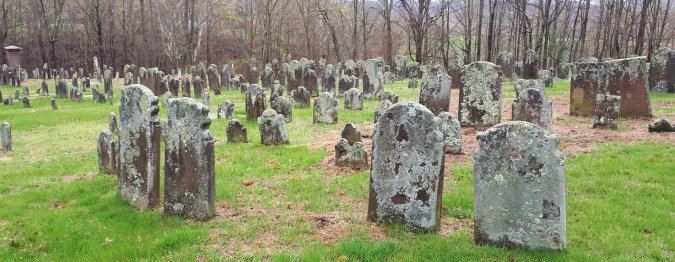
For Easter holiday this year, we had the fortune of traveling to Connecticut to visit my partner’s family, eat a lot of chocolate, and (of course) explore some historic burial grounds. Since this was a short trip we only made it to two, and today I’d like to take you on a little tour of the Old Durham Cemetery in Durham, CT, which opened in 1700!
The modern name of the site includes the word ‘cemetery’ but as you may already know, that term wasn’t utilized in North America until the 1830s, so I’ll continue this post referring to it as a ‘burial ground’ unless using the site’s name. Continue reading →
If you follow me on instagram, you’ve probably seen a photo of the tattoo on my knee. Surrounded by a cluster of foliage, most of which are native plants of British Columbia, is a bold, black hexfoil. I’ve talked about this symbol on the blog before but today I wanted to a bit more of a deep dive into the symbol’s history, it’s distribution, and it’s significance in a mortuary context. If you’re interested in this topic, keep an eye out for my upcoming book “Burial and Death in Colonial North America“, where I will be discussing hexfoils in a mortuary context in much more depth.
This site is near and dear to my little heart, perched on the hill west of the historic site of the Colony of Avalon at Ferryland, Newfoundland. It was one of the sites I explored during my MA thesis (see my publications for a link to the thesis, or wait a few months for the book!), and come to think of it I could very easily populate this series with all NL sites from my thesis research. Would anyone want to read that? Maybe?
Exposed to the often harsh and relentless winds of the North Atlantic ocean, anyone visiting graves in Ferryland in the 18th and 19th centuries would have had an unobstructed view of any passing ice bergs or whales!
View of the Colony of Avalon from the burial ground (photo by author 2015)
Today’s post is based on ongoing research that started as a prompt for a term paper in grad school. I’ve been conducting research on roman lettering development on upright gravestones for some time (there is a paper on the way, I swear. It’s bogged down in reviewer/edits land but it will be out there eventually!), and this research was based on my interest in the development of lettering styles on gravestones. More specifically, the development of lettering styles carved in a ‘remote’ area, that might not have access to lettering books or script trends as carvers in more urban centres in the British Isles were. Lets delve in, shall we?
Update May 28, 2024: Hi there, if you’ve come to this website from an article denying the atrocities of the Canadian residential school systems, please know that my research does not agree with that idea at all. Through oral history and archaeological evidence, it is extremely obvious that numerous children were harmed, killed, and buried on the properties of residential schools. This post discusses the cultural concept of if a grave can ever be considered ‘no longer there’, and the overwhelming answer is no. So even if you think the decomposition of a body warrants the grave disappearing, the answer is no, no it does not. To believe that white settler graves are in perpetuity, and not Indigenous graves, is frankly racist.
This is a topic I’ve discussed with colleagues on several occasions, and most recently in a really engaging thread on twitter: When is a grave…no longer a grave? If ever, at what point might that happen? There isn’t one definitive answer to this question, and the understanding of a grave, its significance, and longevity are rooted in our backgrounds, cultures, and society. I’ve finally found some time to sit down and write up the results of the discussion, and share some thoughts with you all.
This is a particularly special site I’d like to discuss with you today: The Fairview Cemetery, near Oliver, BC. Fairview was a gold mining town in the South Okanagan-Similkameen, born out of the gold rush in the area in the late 1880s. Legend has it that gold was first discovered by a one-armed man in the 1860s, but no Europeans arrived to exploit the areas for gold until the 1880s. It was located just west of the modern-day town of Oliver, and some older homes in Oliver are said to have been built out of wood salvaged from the would-be ghost town.
View from the Fairview townsite over the South Okanagan
It’s that time again friends, where we sit down to highlight yet another one of Canada’s Curious Canadian Cemeteries. Today, lets take a little look at the Brick Street Cemetery in London, Ontario, its history, ongoing protection, and its stone carvers.
I have only visited this site once myself, during London’s Door’s Open event several weeks ago. Doors Open is an event where historic sites and buildings around a city will open their doors free of charge to the public, and it’s a great way to go see museums and heritage sites in your community that you might not otherwise have a chance (or the funds) to visit! We visited several historic sites around town over the course of the weekend, but spent the most time at the Brick Street Cemetery.
Previously on this blog I have discussed what I like to call the “one common skull”. It is a death’s head design, a name given to a motif with a central winged skull, sometimes with crossed bones nearby, or an hourglass, or any other mortality symbol really, and was popular through the 17th and 18th centuries on gravestones throughout eastern North America. The use of mortality symbols in the colonial period draws inspiration from the medieval use of these same symbols to remind viewers of their mortality and was popular across many different groups, not because Puritans were particularly morbid.
This style of gravestone is particularly interesting to me because it is everywhere on the Atlantic coast, throughout the colonial period! While mortuary archaeologists and art historians can say that this style, characterized by the central winged skull with a V-shaped nose in the lunette, small finials with a circular design inside, and the same leafy and circular pattern down the borders around the central text, originated in Massachusetts, it seems like we still don’t know who the carver (or school of carvers) was who is responsible. I don’t have an answer for that yet, but I do want to take a closer look at the chronology of the style in MA compared to imported varieties in Atlantic Canada. Continue reading →
I’m excited to be able to share my public burial archaeology paper, “Public Engagement through Burial Landscapes: Cupids and Ferryland, Newfoundland” with all of you!
It was released today, along with many other articles on public burial archaeology in AP: The Online Journal in Public Archaeology’s Special Volume 3: Death in the Contemporary World: Perspectives from Public Archaeology.
My article discusses ‘lost’ burial grounds – burial grounds which are known to exist, but have yet to be identified – like the 17th-century burial ground at Ferryland, and how discussion with visitors on historic burial practices can often lead to a dialogue on modern burial practices.
If you are interested, I’ve put a link HERE, where you can download the entire volume or each paper individually. It’s an open-access journal too, which is amazing! (If you’re going to do a Public Archaeology journal, it really should be open-access or it’s negating its own point.) I’m so pleased to be able to share this research with you all. While you’re at it, check out the amazing papers by everyone else in the volume, it’s chalked full of deathy-arch goodness!
Citation:
Lacy, Robyn S. 2018. Public Engagement through Burial Landscapes: Cupids and Ferryland, Newfoundland. AP: Online Journal of Public Archaeology, Special Volume 3: Death in the Contemporary World: Perspectives from Public Archaeology. Pp. 55-78. Available online: http://revistas.jasarqueologia.es/index.php/APJournal/issue/view/14/showToc
Last week I had the utter pleasure of attending and presenting my research at Death Salon Boston, put on by the Order of the Good Death and hosted at Mount Auburn Cemetery. For anyone new to this blog / death and burial studies in general, Mount Auburn Cemetery is significant as the first landscaped rural garden cemetery in North America, opening in 1831 and is still an active cemetery today.
My talk, “An Inconvenient Corpse: Winter Dead in colonial Canada” discussed how individuals at early colonial settlements dealt with their dead during the winter. It’s just not something we think about that much! I’d like to summarize my talk in this post for everyone who didn’t get to attend the conference (it sold out so quickly), and just some all around thoughts about my experience at Death Salon Boston!

 Continue reading



 I’m excited to be able to share my public burial archaeology paper, “Public Engagement through Burial Landscapes: Cupids and Ferryland, Newfoundland” with all of you!

