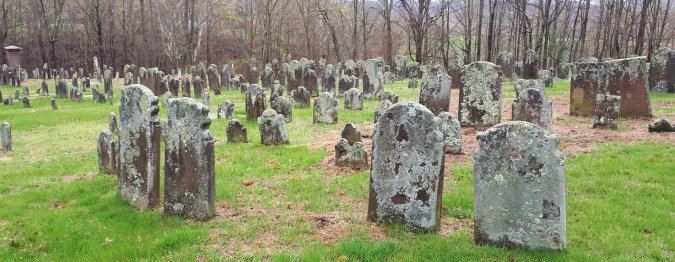
For Easter holiday this year, we had the fortune of traveling to Connecticut to visit my partner’s family, eat a lot of chocolate, and (of course) explore some historic burial grounds. Since this was a short trip we only made it to two, and today I’d like to take you on a little tour of the Old Durham Cemetery in Durham, CT, which opened in 1700!
The modern name of the site includes the word ‘cemetery’ but as you may already know, that term wasn’t utilized in North America until the 1830s, so I’ll continue this post referring to it as a ‘burial ground’ unless using the site’s name. Continue reading →
This site is near and dear to my little heart, perched on the hill west of the historic site of the Colony of Avalon at Ferryland, Newfoundland. It was one of the sites I explored during my MA thesis (see my publications for a link to the thesis, or wait a few months for the book!), and come to think of it I could very easily populate this series with all NL sites from my thesis research. Would anyone want to read that? Maybe?
Exposed to the often harsh and relentless winds of the North Atlantic ocean, anyone visiting graves in Ferryland in the 18th and 19th centuries would have had an unobstructed view of any passing ice bergs or whales!
View of the Colony of Avalon from the burial ground (photo by author 2015)
Update May 28, 2024: Hi there, if you’ve come to this website from an article denying the atrocities of the Canadian residential school systems, please know that my research does not agree with that idea at all. Through oral history and archaeological evidence, it is extremely obvious that numerous children were harmed, killed, and buried on the properties of residential schools. This post discusses the cultural concept of if a grave can ever be considered ‘no longer there’, and the overwhelming answer is no. So even if you think the decomposition of a body warrants the grave disappearing, the answer is no, no it does not. To believe that white settler graves are in perpetuity, and not Indigenous graves, is frankly racist.
This is a topic I’ve discussed with colleagues on several occasions, and most recently in a really engaging thread on twitter: When is a grave…no longer a grave? If ever, at what point might that happen? There isn’t one definitive answer to this question, and the understanding of a grave, its significance, and longevity are rooted in our backgrounds, cultures, and society. I’ve finally found some time to sit down and write up the results of the discussion, and share some thoughts with you all.
This is a particularly special site I’d like to discuss with you today: The Fairview Cemetery, near Oliver, BC. Fairview was a gold mining town in the South Okanagan-Similkameen, born out of the gold rush in the area in the late 1880s. Legend has it that gold was first discovered by a one-armed man in the 1860s, but no Europeans arrived to exploit the areas for gold until the 1880s. It was located just west of the modern-day town of Oliver, and some older homes in Oliver are said to have been built out of wood salvaged from the would-be ghost town.
View from the Fairview townsite over the South Okanagan
Last week I had the utter pleasure of attending and presenting my research at Death Salon Boston, put on by the Order of the Good Death and hosted at Mount Auburn Cemetery. For anyone new to this blog / death and burial studies in general, Mount Auburn Cemetery is significant as the first landscaped rural garden cemetery in North America, opening in 1831 and is still an active cemetery today.
My talk, “An Inconvenient Corpse: Winter Dead in colonial Canada” discussed how individuals at early colonial settlements dealt with their dead during the winter. It’s just not something we think about that much! I’d like to summarize my talk in this post for everyone who didn’t get to attend the conference (it sold out so quickly), and just some all around thoughts about my experience at Death Salon Boston!
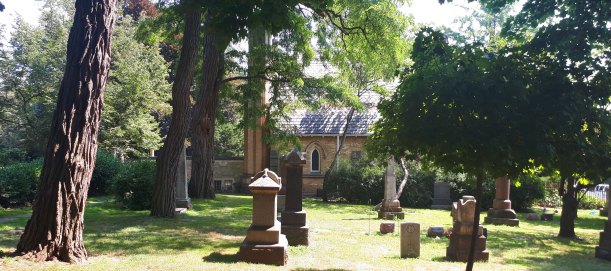
Today on Curious Canadian Cemeteries we are going to take a look at the site that I got a chance to visit last weekend, the Toronto Necropolis!
Last weekend we went to Toronto for the long weekend to visit family, and I was surprised was a visit to the Necropolis. So without further adieu, lets take a look at an amazing, and high profile site! Get ready everyone, this site is amazing!
A little while ago, we went on a mini-holiday to Saratoga Springs, NY, for the Canada Day long weekend. I was very excited to do several things I’ve always wanted to do in Saratoga:
a) Visit some of the springs / drink out of them
b) See a burial ground (literally any, how did I miss doing this last time I was there?)
c) swim in the Victoria pool (this one was added a few weeks before the trip when I found out the pool existed. Totally worth the trip!)
Welcome to the Putnam Burying Ground, which we did not think to call ahead to and therefore couldn’t actually go inside!
View of the Putnam Burial Ground from the street, with the Putnam Family Plot to the left of centre (photo by author, 2018)
Hello burial team, it’s finally time for another addition of Curious Canadian Cemeteries! This week we are looking at the Rockwood Cemetery, in the settlement of Rockwood, Township of Guelph/Eramosa, Wellington County, Ontario. This is my first ‘close-to-me’ cemetery that I’ll be covering!
I’ve talked about Rockwood before on this blog, when I posted about John Harris, my great x4 grandfather, who helped found the current settlement of Rockwood, and Thomas Harris, my great x3 grandfather who constructed Harris Woolen Mill with his brother and brother-in-law. The Mill is still present today by the Eramosa River as a ruin that can be visited and explored! Those very same relatives were buried in the the Rockwood Cemetery.
The sign & chapel at the Rockwood Cemetery (photo by author, 2018)
We’re heading back west for this week’s Curious Canadian Cemeteries installment (ok I know its been a few weeks, but there is work to do and papers to write!), lets take a look at the famous (and rather large) Union Cemetery in Calgary, Alberta.
Funeral procession at Union Cemetery, Calgary, 1911. (Glenbow Archives, NA-2315-6)
I’ve been living in Ontario for a few months now, but in just a couple of days it will finally be time to complete the second half of the move (i.e. moving the rest of the stuff, the car, and my partner). It’s crazy to think that we are going to be leaving the island so soon, but we will definitely be back for loads of visits.
I thought what better way to kick off part 2 of our move…and part 2 of the Curious Canadian Cemeteries Series, than with a site in St. John’s that I have visited on multiple occasions, and even wrote a paper on: The Belvedere Roman Catholic Cemetery.
Yes, that is a tiny out-of-context stone sheep relaxing in the grass.

 Continue reading




 Spade & the Grave