Spade & the Grave

death and burial through an archaeological lens


5 Comments

A Statement.

Friends, we have an issue. Over the last several weeks, my website has been linked by several websites in Canada that are denying the atrocities committed at the residential schools across the countries. I will not link those sites here. They are trying to use my work to bolster their argument there are no ‘lost children’ from Indigenous families, that children were not mistreated, killed, and buried in secret.

These are facts we know from testimonies, records, and the results of countless archaeological investigations across Canada in recent years. You do not need to put a shovel in the ground to see the burials.

The post they are all citing is this one, “When is a grave no longer a grave?“, which I published on Feb 27, 2019. What I was discussing in the post was whether there was or could be a point that a grave is no longer considered to ‘be there’, which is absolutely up to the cultural groups to which the graves belong. Overall, folks I polled on twitter indicated that they believed that a grave is always a grave, regardless of if the state of decomposition. I agree. A burial is a burial in our (settler Canadian) culture, and even cenotaph sites where no body has ever been buried are revered with the same respect as burials. Do those Indigenous children not deserve the same care and respect?

If you found my work through one of these websites and agree with what they are saying, kindly do not come back.


Leave a comment

Catalogue of Octagonal Dead Houses in Ontario: 11th Structure Identified

It has been a while since we’ve gotten to update the Dead House Database (click here), but we have an exciting addition to make! My internet friend and journalist, Warren Schlote, messaged me recently with a drawing of an octagonal dead house posted to instagram by the ‘History Hound’ Richard MacLeod of Newmarket, Ontario. This drawing, done by his grandfather George W. Luesby Sr. (who ran a memorial making business), shows the dead house located in the Newmarket Cemetery, north of Toronto. In this post, we’ll discuss this site and the architect who designed the structure.

Continue reading


Leave a comment

Death & Decay in Cultural Heritage Structures

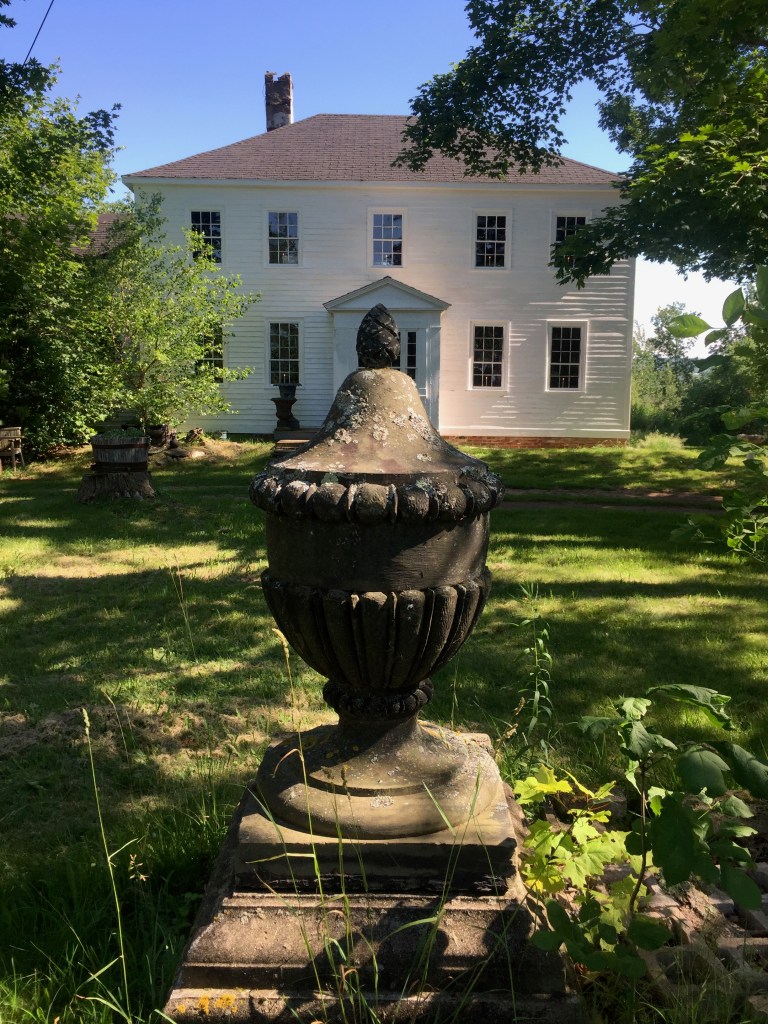
Front Facade

This post was written by myself, Robyn Lacy, and my friend and colleague (and often collaborator) Elizabeth Cushing, of Cushing Design Group.

We have worked in cultural heritage together since 2017, and have spent a lot of time discussing the preservation and curated decay in heritage structures. I’ve written about curated decay before on my blog, but today we wanted to discuss decay within structures, and highlight the design and historical significance of this Georgian style home in Upper Canard, Nova Scotia. All photographs in this post were taken by Elizabeth Cushing, unless otherwise noted.

This magnificent Georgian country estate, complete with summer kitchen to the left of the main house, was constructed in 1790 and was the childhood home of Sir. Frederick Borden (no relation to Charles Borden, who developed the Borden System, which is used to define the location of all archaeological sites in Canada). Sir Frederick William Borden (1847-1917) was a physician, businessman, militia officer and politician who practiced medicine in Canning, while also investing in ships, utilities and real estate. He was an investor in the Cornwallis Railway Company Limited, the Canning Water and Electric Light, Heating and Power Company Limited and the Western Chronicle, and owned two 125 to 150 ton vessels. 

Continue reading


1 Comment

On the Eighth Day: An Explanation for Octagonal Dead Houses

Hello again, fellow death & burial enthusiasts! My goal with these posts is to share my love of a type of structure that isn’t widely written about (clearly my goal is to change that), and inform you all about a burial practice that was reserved for the colder parts of the world…Canada, parts of the USA, the UK, etc. My research on the practice has been restricted to North America and the British Isles thus far, though it is also clear through readings that winter body storage had to happen in many other places as well (ie. Iceland). I can’t wait to dive in further!

Today I wanted to talk about why some of these structures are octagonal in Ontario, as opposed to a standard rectangular or subterranean structures. There might be a method to this madness!

5886003_05964f10_1024x1024

The 15th-century octagonal font at Stoke-by-Nayland, Suffolk, UK. (Image by Michael Garlick 2018)

Continue reading


6 Comments

Significant Women of Brick Street Cemetery: Phoebe McNames, Silvany Tunks, & Hannah Caldwell

It’s a common theme throughout history, that women’s stories are swept under the rug, intentionally or not, to make way for the stories of history’s great men. Of course, with cis women, trans, queer, and otherwise non-gender-conforming individuals being present throughout history, the tales of ‘men’ are only a small fraction of the whole story.

Gravestones from the 19th century have a common formula when it comes to remembering women, and that is by labelling them as wife of… and often not providing any additional information about them. Often nothing much is recorded throughout history about them either, making it even more difficult to find anything else out other than who they married. Today I’d like to talk about three young women who are buried at Brick Street Cemetery, and were early settlers in the area in the mid-19th century: Phoebe McNames, Silvany Tunks, & Hannah Caldwell.

20180916_111725 copy

Continue reading


1 Comment

Brick Street Cemetery Stories: Quaker Stones & Attempted Murder

Hi all, can you believe it’s already nearly the middle of August? I can’t! It feels like just yesterday that I was starting my work at Woodland Cemetery. Tragically, that contract has ended, and I am working for another local historic cemetery for the next month or so, combing through their archival materials to create a book manuscript about the background of the site, their significant people and stories, and transcriptions of the gravestones themselves. Keep your eyes peeled, folks. It promises to be an interesting project!

20190805_140013

Continue reading


1 Comment

Gravestone Conservation 2019: Week 5 & 6

There has been a lot of work going on over the last two weeks! So much that last weekend was super busy and I didn’t have time to write a blog post. I went to a bridal shower, worked on an article for ages (& finnnNALly submitted it), visited a cottage with my friends, and did a bunch of other things. Bye weekends, I hardly knew you!

You’ll all be pleased to know we only had like 2 rain days over the last two weeks, so there is a little more to talk about! We fixed so many stones, uncovered some extra dramatic stories, did a couple tours, worked with a practicum student, went of a tree-tour of the cemetery, and fought with the drill! That last part doesn’t sound as dramatic to you as it was, but stay with me…

xxx20190617_151903

Tools of the trade!

Continue reading


1 Comment

Curious Canadian Cemeteries: Union Cemetery, Calgary, Alberta

We’re heading back west for this week’s Curious Canadian Cemeteries installment (ok I know its been a few weeks, but there is work to do and papers to write!), lets take a look at the famous (and rather large) Union Cemetery in Calgary, Alberta.

UnionCemeteryFuneral1911

Funeral procession at Union Cemetery, Calgary, 1911. (Glenbow Archives, NA-2315-6)

Continue reading


1 Comment

Curious Canadian Cemeteries: St. Saviour’s Anglican Cemetery, Penticton, British Columbia.

Hello there, death and burial aficionados! I come to you today with a new series that I’m starting on Spade & the Grave called ‘Curious Canadian Cemeteries’ (cemeteries because it works for the 3 C’s, not because I totally agree with the term for all sites). Recently, I’ve noticed that a lot of publications that talk about burial sites around the world tend to gloss over Canadian sites, and I’d love to bring a few of the amazing burial grounds across the country into a bit of the spotlight! So if you have any interesting suggestions, I’d love to hear them! I’m going to try to make this either a weekly or bi-weekly feature on the blog, amidst other posts as I think of them.

Burial grounds, graveyards, cemeteries…whatever the terminology is for the site, every one holds a unique history and place within the landscape. While large, famous sites like Mount Auburn Cemetery or the Granary in Boston see visitors every day due to their publicity (and amazing monuments), there are hundreds of smaller burial grounds across North America and the world, that have just as rich of a back story, but might not be quite so obvious to the burial ground visitor on the go. Sites like these were meant to be visited, cared for, and enjoyed. They were created for the living just as much as the dead, and visiting historical burial grounds isn’t morbid. So without further adieu, lets virtually visit some unique burial grounds, from across Canada!

For my first post in the series, I wanted to feature a graveyard from one of my childhood homes, and the place that I lived in for the longest:
Penticton, British Columbia.

20181223_141927xxx

Penticton, BC, viewed from Munson Mountain (photo by author 2018)

Continue reading


12 Comments

Winter Corpses: What to do with Dead Bodies in colonial Canada

Dead_House__from_North_East_Nain_Labrador

Dead house in Nain, Labrador (Jarvis 1995. From the Memorial University of Newfoundland-Intangible Cultural Heritage Inventory

Welcome back, dear readers, to another installment of a blog about burial practices and archaeology! Today I’d like to talk about something that is close to by heart (as the result of arguing about it during my thesis): What did people do with their dead bodies during the winter, in colonial Canada?! Well, there are a few options to discuss but the short answer is…

Keep them.
Continue reading