Spade & the Grave

death and burial through an archaeological lens


1 Comment

Tales from the Trenches: Ferryland Week 3, 2017

Here we are, 3/4 weeks complete for the 2017 field season!
Cumulatively, this makes my 9th week excavating at Ferryland in search of the 17th-century burials. Lets go over what we uncovered this passed week, and then I’d like to talk about visitors to public archaeology sites and what we know so far about the burial ground!

blog3_5

Continue reading


1 Comment

Tales from the Trenches: Fieldwork Week 2, 2017 (or, why does this keep happening?)

Halfway through through the fieldwork season, and I already cannot believe the amount of earth we’ve moved in pursuit of the burial ground! It’s amazing, thank you to the week 1 & 2 crews for all the hard work you put in, I couldn’t have gotten this far without all of you (and your digging hands)!

It was an amazing week over all, so lets dive right in to what we got up to at Ferryland last week:

blog2_3

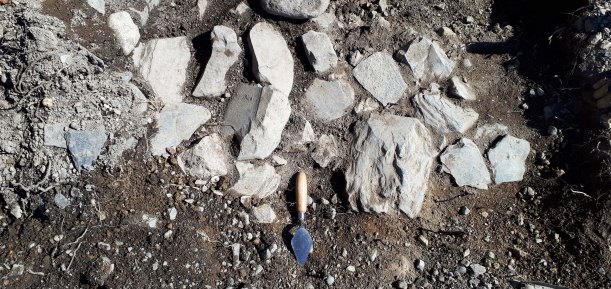
17th-century building rubble from the brewhouse dismantling. We found lots of early-mid-17th-century objects between the fallen stones, as well as rich organic soil, charcoal, burned bones, and other organic material. Photo by author, 2017.

Continue reading


2 Comments

Tales from the Trenches: Fieldwork Week 1, 2017.

It’s time.
The trowels are cleaned*, the boots are dusted off**, and the car is ready and full of excited and bright eyed volunteers***. The fieldwork season has begun!

*it’s never really going to be clean again, is it?
**Same goes for the boots, they are as dusty as ever
*** No one is that bright eyed at 6:30AM!

If you remember from my last post, I had indicated where I was going to be excavating this summer by a large circle on the map. Of course, I’m not going to be digging literally all of the space inside that circle but a few select trenches to get a better idea of what is going on in the subsurface.

20170704_094258

The first trench laid out over the gravel slope. It’s mostly slopewash and debris from above, and parts of the area were previously excavated so the ground lever was actually much higher than it currently appears to be! Photo by author, 2017.

Continue reading


2 Comments

Search for the 17th-century Ferryland burial ground, 2017: Introduction

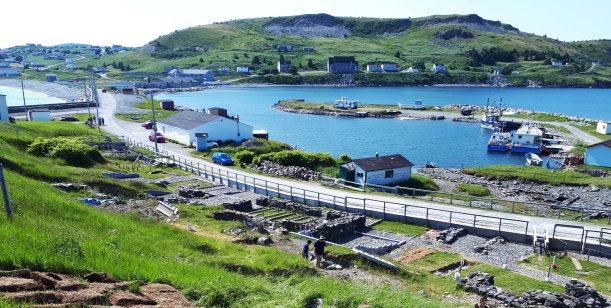
Tomorrow is the day! The 2017 excavation at Ferryland is finally going to start and I couldn’t be more excited! (That’s a lie, I will be more excited when I get on site tomorrow). I wanted to take this opportunity to tell you all a bit more about this year’s excavation and where I am taking it for the next 4 weeks. I’ll be blogging every week about the latest adventures and finds as well and I hope you all come along for the ride!

RL_Ferryland_Map_Overview

Map made by Robyn Lacy & Bryn Tapper, 2017.

This is a map I made under the guidance of Bryn Tapper, a PhD candidate in my department who knows way more about GIS that I do! It’s an aerial photo of the Ferryland harbour, centered on the 17th-century British settlement area in the Pool, with a later, known burial ground circled in red on the left side of the image. The Pool refers to that little curl of land in the middle of the image, which formed naturally, if you can believe it! It’s the perfect little protected harbour, and deep enough to bring ships into, making it a wonderful location for a small settlement 400 years ago.
Continue reading


1 Comment

Living History Radio Interview: Headstones, Hexfoils, and Historical Archaeology

Interview

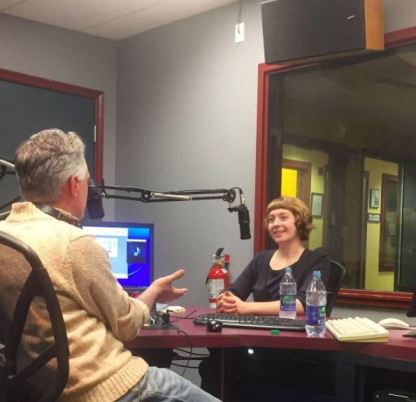
First time in a radio studio! Photo from @ICH_NL

Recently I was invited to come chat about my research on colonial burial landscapes on the radio show / podcast ‘Living Heritage’. The show, hosted by Dale Jarvis and broadcast on CHMR – 95.3 FM (and apparently other radio stations across Canada, you might just hear me talking about graves out of the blue), focuses on people which cultural heritage in many different capacities.

This was my first radio interview, and my first time seeing a microphone that is kind of suspended in front of your face in real life! I’m more excited about that than I should be.. but it was such a cool experience, and I had a ton of fun recording the episode with Dale! We mostly talked about my research and some of the topics that I’ve discussed here on the blog with you guys, hexfoils, stone importation to Newfoundland, etc. Death and Burial sorts of things!

Without further adieu, you can listen to the full episode by  CLICKING HERE!

You can also visit the ‘Intangible Cultural Heritage’ Blog and read about / listen to the interview HERE.

IMG_-pfiaa7

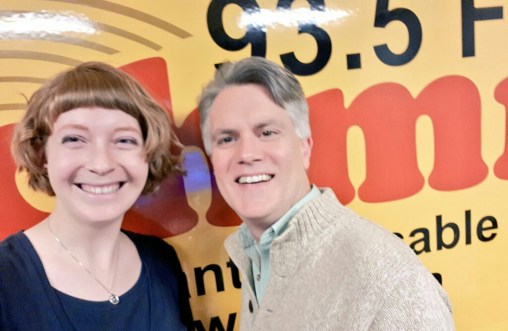
Gotta have a selfie to commemorate. Thanks for having me on the show!


8 Comments

Death & Commemoration at Ferryland – What we know so far.

I did say that my next post was going to be about the Ferryland gravestones, so here we are! Before I can get into the stone analysis bit though, we first need to discuss death at Ferryland.

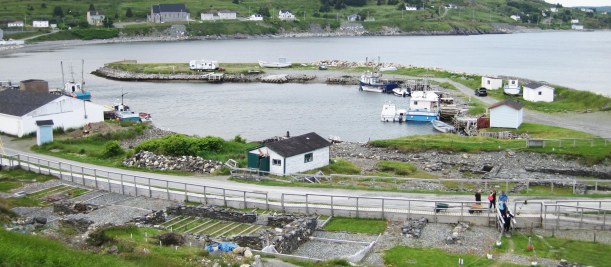
Ferryland had long been known as a good harbour before the establishment of the 1621 settlement. In fact, there have been Beothuk hearths found at Ferryland, but their relationship (if any) with migratory European fishermen prior to the settlement being founded is unknown. The natural spit that juts out into the water creates a protected harbour, breaking waves and keeping boats sheltered from the harsh Atlantic storms. It was a natural place for people to want to live, and to die.
IMG_4664 Continue reading


7 Comments

Outsourcing Monuments? – Gravestone carving VS. importation in Newfoundland

20160911_144257In a place often referred to as ‘The Rock’, it sounds a bit redundant to be importing gravestones, but for a period in the 18th-early 19th century, that is exactly what people in Newfoundland were doing. By people, I of course mean people who could afford to have gravestone carved overseas and shipped across the ocean. There are locally carved gravestones as well going back to the 17th-century! I even have a puzzle for all of you gravestone enthusiasts out there, but we’ll get to that in a moment.
Continue reading


Leave a comment

Tales from the Trenches – Mystery Soil Stains & an Unexpected Discovery

Archaeology isn’t quite like they show it in the movies or on Time Team. Of course, we all wish we could just walk into an area, feel the wind, and know exactly where a site is but unfortunately it doesn’t work like that (and we usually have more than 3 days if excavations are happening too)!
IMG_4538
Last summer during my excavation at Ferryland, there were quite a few moments that started out feeling as if we’d found something very dramatic, which quickly dissolved into mild disappointment and sighs. But that’s archaeology right? If you’re doing a project that is looking for something, rather than trying to see what was happening in general, then there are going to be a lot of empty test pits. This one wasn’t empty though…

Continue reading


10 Comments

Ground Penetrating Radar in search of Graves – Newfoundland Edition

This morning I thought it might be fun to talk about geophysical scanning techniques.

TorsCove_GPR1_3_RL

SmartCart with 500mhz antenna, GPR survey at Tors Cover, 2016. Photo by author.

If you are coming to this blog knowing about what I was up to in the field last year, or having read my CAA poster last week, you’ll know that I attempted a wide-scale Ground Penetrating Radar (GPR) survey at Ferryland, Newfoundland, in May of 2016, with the help of our wonderful curator and GPR tech, Maria Lear. I was looking for anomalies in the results that could indicate a burial in the subsoil, either high-contrast anomalies that might suggest a coffin or coffin hardware or a depression or slump in the soil layers where a grave had settled over time. What were my results? We’ll get to that in a moment!

Continue reading


2 Comments

Welcome to Spade & the Grave

Good morning.

As I sit here trying to decide what to decide what exactly one is supposed to write to open a website up, to really invite people in, I can’t help but glance at my ‘academic’ bookshelf. There probably shouldn’t be quotations around that, that categorizes most of my books! There are books on medieval churches, old museums, lithic technologies, geoarchaeology, gravestone scripts, and the list goes on and on. The running theme between them all? Everyone that they talk about, all of the past peoples who used to populate the cities and countrysides of the world, have long since died.

T8_image

But that’s what archaeology is, isn’t it? We study the past, and that means dealing with mortality on a near-daily basis. As someone who originally intended to go into maritime archaeology and ‘got distracted’ in a graveyard during my field field school, I think about death and dying pretty regularly. My own research is fairly landscape based (we’ll talk about that later), but in order to get to a spatial analysis I have to understand why certain spaces may have been used as they were, which means trying to death and burial practices, anxieties, and ideals for lots of different groups of people.

This blog was created after several colleagues and many visitors to the dig asked if I had a website. Spade & the Grave will contain aspects of my ongoing research, fieldwork updates during the summer, and interesting explorations into death and burial as I come across them. I hope you all enjoy, and get in touch if you want to know more!

Welcome to Spade & the Grave.

(photos are my own)