Spade & the Grave

death and burial through an archaeological lens


3 Comments

Doors Open London: London’s historic burial grounds

This past weekend was Doors Open London, which is a weekend where historic sites and buildings open their doors to the public, free of charge to allow everyone to see places that they might not otherwise have a chance to experience. It’s an awesome time to be a tourist in your own town, and quite a lot of cities participate in the ‘Doors Open’ concept, all throughout the year! See if your city does…and if not, maybe encourage them to??

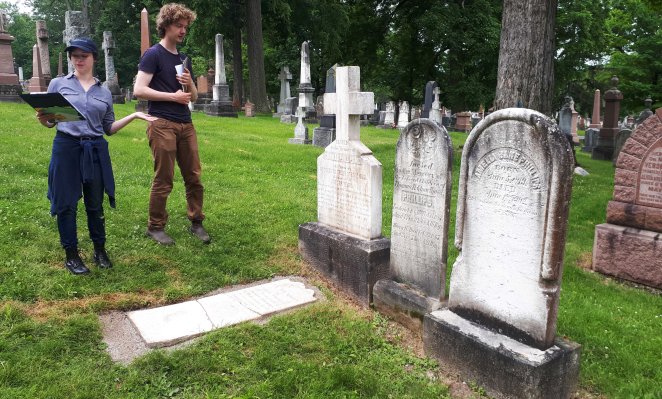
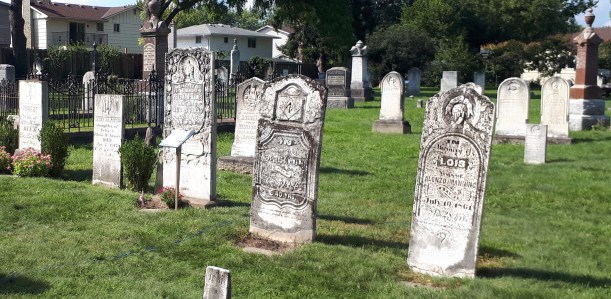
I had the pleasure of volunteering on Saturday at two sites: Brick Street Cemetery and Woodland Cemetery, both of which you’ll have heard oodles about already if you’ve been following my blog. There were some pretty cool things going on, and it was an awesome opportunity to participate in some public outreach and public archaeology!

20190914_122614

Continue reading


6 Comments

Significant Women of Brick Street Cemetery: Phoebe McNames, Silvany Tunks, & Hannah Caldwell

It’s a common theme throughout history, that women’s stories are swept under the rug, intentionally or not, to make way for the stories of history’s great men. Of course, with cis women, trans, queer, and otherwise non-gender-conforming individuals being present throughout history, the tales of ‘men’ are only a small fraction of the whole story.

Gravestones from the 19th century have a common formula when it comes to remembering women, and that is by labelling them as wife of… and often not providing any additional information about them. Often nothing much is recorded throughout history about them either, making it even more difficult to find anything else out other than who they married. Today I’d like to talk about three young women who are buried at Brick Street Cemetery, and were early settlers in the area in the mid-19th century: Phoebe McNames, Silvany Tunks, & Hannah Caldwell.

20180916_111725 copy

Continue reading


1 Comment

Brick Street Cemetery Stories: Quaker Stones & Attempted Murder

Hi all, can you believe it’s already nearly the middle of August? I can’t! It feels like just yesterday that I was starting my work at Woodland Cemetery. Tragically, that contract has ended, and I am working for another local historic cemetery for the next month or so, combing through their archival materials to create a book manuscript about the background of the site, their significant people and stories, and transcriptions of the gravestones themselves. Keep your eyes peeled, folks. It promises to be an interesting project!

20190805_140013

Continue reading


Leave a comment

Gravestone Conservation: Week 7

My goodness, what a whirlwind these past 7 weeks have been! With only one week to go, I can’t believe I’m nearly finished with these weekly(ish) blog updates of my training and work as a gravestone conservator. Here we go people, I can fix gravestones and know more about stone than I did two months ago! Does anyone want me to talk about stones forever…because too late, I’m never going to stop!

It was an exciting and productive week at the cemetery, so lets dive in! It was only a four-day week because last Monday was Canada Day, so I’m pretty impressed with all the things we got done.

xxx20190702_094417(0)

Meagan & Thomas, archivist/historians, preparing for the July 6 tours.

Continue reading


1 Comment

Gravestone Conservation 2019: Week 5 & 6

There has been a lot of work going on over the last two weeks! So much that last weekend was super busy and I didn’t have time to write a blog post. I went to a bridal shower, worked on an article for ages (& finnnNALly submitted it), visited a cottage with my friends, and did a bunch of other things. Bye weekends, I hardly knew you!

You’ll all be pleased to know we only had like 2 rain days over the last two weeks, so there is a little more to talk about! We fixed so many stones, uncovered some extra dramatic stories, did a couple tours, worked with a practicum student, went of a tree-tour of the cemetery, and fought with the drill! That last part doesn’t sound as dramatic to you as it was, but stay with me…

xxx20190617_151903

Tools of the trade!

Continue reading


2 Comments

Gravestone Conservation 2019: Week 2

Hello all, welcome back to another ‘updates from the field’ style post, where I’d like to discuss what we got up to at the cemetery this week! It was an extremely busy week, and we got quite a lot accomplished, and learned a load of new skills throughout it all that I am very excited to use throughout this program and hopefully throughout my career as a historical archaeologist.

xxx20190527_113830

Little woodchuck friend coming to see why we were digging so many holes in their field! 

Continue reading


24 Comments

The Geologic Composition & Weathering of Gravestones.

If you are new to the study of burial markers and don’t come from a geologic background or have prior knowledge in basic geology, grasping the differences in materials found in burial grounds might seem like a monumental task! In this post, we will be discussing the composition and problems/perks of different stone types that are found across North American historical burial grounds, as well as common weathering issues that can be seen across these stones. I do my best to keep this post up to date as I learn more about the geologic processes at work in our historic cemeteries and graveyards.

(last update: December 4, 2023)

xxx20190409_151140
Woodland Cemetery, London. ON. (Photo by author 2019).
Continue reading


1 Comment

Evolution of roman lettering in Newfoundland: A case study at Belvedere Roman Catholic Cemetery, St. John’s, Newfoundland

Today’s post is based on ongoing research that started as a prompt for a term paper in grad school. I’ve been conducting research on roman lettering development on upright gravestones for some time (there is a paper on the way, I swear. It’s bogged down in reviewer/edits land but it will be out there eventually!), and this research was based on my interest in the development of lettering styles on gravestones. More specifically, the development of lettering styles carved in a ‘remote’ area, that might not have access to lettering books or script trends as carvers in more urban centres in the British Isles were. Lets delve in, shall we?

Capture

St. John’s Harbour (photo by author 2016)

Continue reading


6 Comments

When is a grave no longer a grave?

Update May 28, 2024: Hi there, if you’ve come to this website from an article denying the atrocities of the Canadian residential school systems, please know that my research does not agree with that idea at all. Through oral history and archaeological evidence, it is extremely obvious that numerous children were harmed, killed, and buried on the properties of residential schools. This post discusses the cultural concept of if a grave can ever be considered ‘no longer there’, and the overwhelming answer is no. So even if you think the decomposition of a body warrants the grave disappearing, the answer is no, no it does not. To believe that white settler graves are in perpetuity, and not Indigenous graves, is frankly racist. 

This is a topic I’ve discussed with colleagues on several occasions, and most recently in a really engaging thread on twitter: When is a grave…no longer a grave? If ever, at what point might that happen? There isn’t one definitive answer to this question, and the understanding of a grave, its significance, and longevity are rooted in our backgrounds, cultures, and society.  I’ve finally found some time to sit down and write up the results of the discussion, and share some thoughts with you all.

pubandcontbanner

Continue reading


1 Comment

Built Heritage, Mortality, & Decay

As I may or may not have explained on this blog already, I work in built heritage. That means that I deal with the archaeology of standing buildings. In North America it is often referred to as cultural heritage, and is a facet of historical archaeology that I am quite passionate about (and who doesn’t like getting to go into old houses all the time!).

Lately, I’ve been doing a bit of reading into the conscious curation of decaying built heritage. It’s a very interesting topic, and while it’s hard to get away from the mentality that all old buildings are worth saving / preserving / restoring, curation of decay doesn’t mean justification for letting something fall into disrepair that perhaps does need some restoration but rather the ability to see and to interpret the change of a space, its meaning, and its place in history as it becomes overgrown, crumbles, or falls.

20160701_152737 (2)

Continue reading