
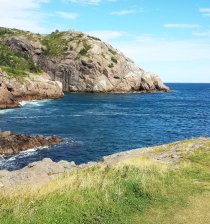
 In a place often referred to as ‘The Rock’, it sounds a bit redundant to be importing gravestones, but for a period in the 18th-early 19th century, that is exactly what people in Newfoundland were doing. By people, I of course mean people who could afford to have gravestone carved overseas and shipped across the ocean. There are locally carved gravestones as well going back to the 17th-century! I even have a puzzle for all of you gravestone enthusiasts out there, but we’ll get to that in a moment.
Continue reading
Category Archives: Uncategorized

Medieval Graffiti in a (historic) New England Context
That title should also have the word ‘mortuary’ in it somewhere, but you probably guessed that’s where I’m going with this! Today I wanted to talk about above-ground material culture relating to historic burials. More specifically, about the classic gravestones of colonial New England and symbology that appears with some regularity throughout the region that display an iteration of several compass-drawn symbol often found in medieval churches and on items of furniture in the British Isles.

‘Ye Antientist Burial Ground’, 1652~, New London, Connecticut. Photo by author, 2015
Tales from the Trenches – Mystery Soil Stains & an Unexpected Discovery
Archaeology isn’t quite like they show it in the movies or on Time Team. Of course, we all wish we could just walk into an area, feel the wind, and know exactly where a site is but unfortunately it doesn’t work like that (and we usually have more than 3 days if excavations are happening too)!

Last summer during my excavation at Ferryland, there were quite a few moments that started out feeling as if we’d found something very dramatic, which quickly dissolved into mild disappointment and sighs. But that’s archaeology right? If you’re doing a project that is looking for something, rather than trying to see what was happening in general, then there are going to be a lot of empty test pits. This one wasn’t empty though…

Ground Penetrating Radar in search of Graves – Newfoundland Edition
This morning I thought it might be fun to talk about geophysical scanning techniques.

SmartCart with 500mhz antenna, GPR survey at Tors Cover, 2016. Photo by author.
If you are coming to this blog knowing about what I was up to in the field last year, or having read my CAA poster last week, you’ll know that I attempted a wide-scale Ground Penetrating Radar (GPR) survey at Ferryland, Newfoundland, in May of 2016, with the help of our wonderful curator and GPR tech, Maria Lear. I was looking for anomalies in the results that could indicate a burial in the subsoil, either high-contrast anomalies that might suggest a coffin or coffin hardware or a depression or slump in the soil layers where a grave had settled over time. What were my results? We’ll get to that in a moment!

Fallout Bunker Burials
I recently had the opportunity to visit Ottawa & Gatineau to attend the 50th Canadian Archaeology Association Conference, hosted by the Canadian Museum of History. It was an amazing meeting, and gave me the chance not only do discuss my research with a ton of Canadian archaeologists from all across the country and hear some really ridiculous stories, but also to connect with people whom until then I had only known through a digital network (twitter).

There were several very interesting talks on indigenous and historic burials at the conference, including several on remote sensing of graves (that is for another day, however!). After the conference, I got the opportunity to go on a tour of the Diefenbunker! It’s one of those sites that you hear about in high school social studies, giggle at the name of, and then don’t think about again until it comes up in the list of events at your conference. I knew I had to be on the tour, but I didn’t know that part of the tour was going to be about death! Lucky me, right? Continue reading

Welcome to Spade & the Grave
Good morning.
As I sit here trying to decide what to decide what exactly one is supposed to write to open a website up, to really invite people in, I can’t help but glance at my ‘academic’ bookshelf. There probably shouldn’t be quotations around that, that categorizes most of my books! There are books on medieval churches, old museums, lithic technologies, geoarchaeology, gravestone scripts, and the list goes on and on. The running theme between them all? Everyone that they talk about, all of the past peoples who used to populate the cities and countrysides of the world, have long since died.

But that’s what archaeology is, isn’t it? We study the past, and that means dealing with mortality on a near-daily basis. As someone who originally intended to go into maritime archaeology and ‘got distracted’ in a graveyard during my field field school, I think about death and dying pretty regularly. My own research is fairly landscape based (we’ll talk about that later), but in order to get to a spatial analysis I have to understand why certain spaces may have been used as they were, which means trying to death and burial practices, anxieties, and ideals for lots of different groups of people.
This blog was created after several colleagues and many visitors to the dig asked if I had a website. Spade & the Grave will contain aspects of my ongoing research, fieldwork updates during the summer, and interesting explorations into death and burial as I come across them. I hope you all enjoy, and get in touch if you want to know more!
Welcome to Spade & the Grave.
(photos are my own)
 Spade & the Grave