I suppose I can’t start off every post by apologising for not writing forever, but it has been nearly 6 months so I suppose I’d better do it this time. Sorry, friends! Life has been going fast and I have a lot of projects on the go at the moment, both at work and on my own time, so writing a research blog for fun has been pushed to the side. However! I’m in the middle of writing my next book project, ‘A Graveyard Guide to Eastern Newfoundland’ (tentative title, does anyone have anything snappier??), and I got sucked into a research rabbit hole last night for several hours writing about a specific gravestone, so I wanted to share that excitement with everyone!
Harbour Main is a small outport community on the south coast of Conception Bay, Newfoundland and Labrador. It is well known for its gorgeous beach called ‘The Tide’, but it’s known mostly to me for being home to a small early cemetery that my friend Katie took me to see back in 2021. At this site, called The Old Irish Cemetery or the Old Irish Roman Catholic Cemetery, there are a number of field stones and other locally carved markers, but one in particular has stuck in my mind, because it’s inscribed in French.
View across the Old Irish Cemetery, Harbour Main in the fog (Lacy 2021).
If you haven’t heard of Loren Rhoads’ fantastic book ‘199 Cemeteries to See Before You Die’, then you’re missing out! Luckily, Loren has released an updated version! Black Dog & Leventhal Publishers kindly sent me a review copy, and I’ve had the best time checking out the new edition! You can purchase the book directly from the publisher by clicking HERE or by asking your local bookshop or wherever you buy books!
Loren Rhoads is an author and editor of numerous fiction and non-fiction books, and is a longtime cemetery history expert and enthusiast. She has served as a cemetery consultant for AAA, The Weather Channel, Mental Floss, and Atlas Obscura among many others, and currently resides in San Francisco, where there are no active cemeteries.
The gorgeous new book! Thank you Black Dog & Leventhal Publishers!
The book is a great guide to visiting cemeteries around the world, with tidbits about the history of the sites and the significant people who are buried there. Each site entry includes the location of the site, and a website about the site if it’s available. It’s such a great way to explore the history of a new place through the people who created it and the artworks they left behind!
The book covers sites primarily in the USA, with 101 sites introduced throughout the pages. There are 7 sites included in Canada, which was very exciting for me as a Canadian archaeologist! The first edition of this book only had 5, and it was great to see that expanded a bit more! The rest of the book is primarily divided up by region: Central and South America and the Caribbean, Europe, Eastern Europe, the Middle East, Africa, Asia, and Oceania. While the book clearly skews heavily towards American sites, this makes sense as both the publisher and author are based in the States.
I was really impressed with the breadth of sites that Loren covers throughout the book. For the Canadian sites, Saint Mark’s Churchyard in Niagara-on-the-Lake, ON and the Hunt Family Cemetery on Vancouver Island, BC were new additions. As a Canadian archaeologist and cemetery enthusiast, I was very excited to see this! Saint Mark’s Churchyard is a notable site, the final resting place of William Riley and John Waters, Black residents in the area, as well as the site of large trenches cut through the graveyard during the War of 1812. The Hunt Family Cemetery is located on the land of the Kwakwaka’wakw people of Vancouver Island, who occupied the region long before the arrival of European settlers, and occupied different areas based on the seasons. Their lives were permanently disrupted by the construction of a Hudson Bay fort, Fort Rupert, in 1851. The Europeans brought smallpox to the Indigenous people, and the fort was abandoned only a few decades later in 1882. The cemetery is located near the Kwakiuli Band Longhouse, where much of the art was carved by local Kwakwaka’wakw artist Calvin Hunt and other family members, to commemorate family buried there. I really appreciated Loren’s inclusion of an Indigenous site in the Canadian section, and her thoughtful discussion of the impact of colonialism and residential schools on the community.
Visually, I love the redesign of the new book! The original version was black, with gates opening into a mossy cemetery. Gold filigree decorates the top of the cover, and the exterior edges of each page inside. The new version is brighter, with a stunning southern cemetery with a large tree dripping in Spanish moss covering the entire cover, with a narrow white border around the edge. The filigree is removed from the interior pages, which I think makes the pages less busy. It draws your focus to the photos, I think it was a good choice. I’m of the mind that cemeteries aren’t always morbid or creepy, so I love a book about burial grounds that aren’t dark and gloomy looking.
‘222 Cemeteries to See Before You Die’ ends with the grave of author Robert Louis Stevenson, located in Samoa. The book covers all corners of the globe, introducing the reader to burial practices from numerous different cultures, and is a great introduction to regions you might not have already been familiar with as a burial ground enthusiast. Overall, this updated volume is absolutely wonderful, and would be a great addition to the bookshelves of any taphophiles or history fans in your lift! 10/10!
Exciting news, friends! I’m pleased to announce the release of my second book, “Daisy Wheel, Hexfoil, Hexafoil, Rosette: Protective Marks in Gravestone Art“, with Berghahn Books! It’s now available for pre-order, with publication in September 2024!
Pre-orders are now available through Berghahn’s website, click the link HERE to check it out! Just like with novels if you follow any authors online, you’ll know that pre-ordering a book is really important if you want to support that author because it lets the publisher know that there are people out there excited for the release and gives them an idea of demand and of the book’s success. You can also support the book (and me) by requesting that your library order a copy!
The cover of my upcoming book, provided by my editor at Berghahn Book!
A huge thank you to my editor, Caryn Berg, for reading my abstract for the 2020 SHA conference talks and reaching out to me with this project idea. I have been so thrilled to turn what has really been a huge interest for many years into something more tangible, and to have the opportunity to explore it in depth. Protective marks, aka apotropaic marks, can be found throughout many parts of the world, from Rome to Egypt, and England to North America and Australia. They were likely used to provide protection, like a lucky charm might, and can be found everywhere from churches to homes, to gravestones. The purpose of this book was to explore their use in a mortuary context throughout history, with a survey of colonial gravestones in North America that constitutes the first study of its kind of these symbols. It has been noted in gravestone research for decades that hexfoils and whorls are present in gravestone art, with a nod towards their apotropaic history, especially in the UK, but no further work had been carried out, and I hope with this volume that I’ve added a little to that conversation!
It has been a while since we’ve gotten to update the Dead House Database (click here), but we have an exciting addition to make! My internet friend and journalist, Warren Schlote, messaged me recently with a drawing of an octagonal dead house posted to instagram by the ‘History Hound’ Richard MacLeod of Newmarket, Ontario. This drawing, done by his grandfather George W. Luesby Sr. (who ran a memorial making business), shows the dead house located in the Newmarket Cemetery, north of Toronto. In this post, we’ll discuss this site and the architect who designed the structure.
At the end of October, I had the wonderful opportunity to travel to Mexico City with my husband, and our friends Katie and Mike, for the wedding of our dear friends, Mariana and Ramon. It was a magical experience, and none of us had ever been to Mexico before (except for the newly weds, who are in fact, from there). What a gorgeous place! We were there over Day of the Dead (Dia de Muertos), and were able to do some touristing on our trip thanks to the guidance of our local friends, and learned so much about Mexican culture and tradition surrounding Day of the Dead, as well as some archaeological sites! Lets dive in.
Reconstructed tzompantli at the Museo el Templo Mayor.
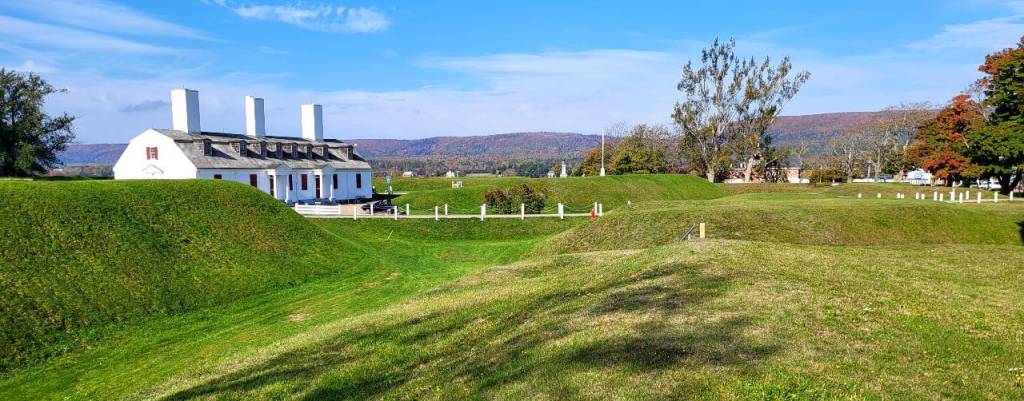
Happy November, readers! It’s been a hectic last few weeks in our house, and I think I’ve spent just as much time living out of a suitcase this fall as I have at home… still not unpacking my suitcase. Whoops. Early in October, I travelled to Nova Scotia for a week for my PhD research. I visited the Nova Scotia Archives, the Old Burial Ground, the Nova Scotia Museums offsite storage, and travelled out to Annapolis Royal to visit the Garrison Burying Ground and meet with Parks Canada and Mapannapolis staff in order to discuss the history of the site. It was a really amazing trip, and I got to stay with my dear friends in Dartmouth as well, which is just a research trip bonus!
Lets go!
Fort Anne, Annapolis Royal, from the site of the church looking towards the centre of the site over the earthworks (photo by author 2022).
This week we wrapped up my fieldwork surveying in New Perlican! This part of my project, which I’ve written about a few times already in earlier blog posts, involves using a total station theodolite to survey and record the location of gravestones at historic burial grounds in New Perlican in order to create maps of the sites for the local archives and to use in my dissertation research on the evolution of the burial spaces in a single community over 400 years. You can find those earlier posts here: PhD Fieldwork Part 1, PhD Fieldwork 2, and Burial Ground Mapping.
This last round of surveying (before all the total stations vanished to field schools and Labrador for the summer) took place at St. Augustine’s Cemetery 1, and yes, there is a second one of the same name! Due to the size and complexity (ie: trees) of the site, I decided to record only the field stones at this location. Often overlooked, field stones are locally sourced grave markers that typically don’t have inscriptions but show a lot of importance in burial marking traditions in a community.
The goats (and sheep) of New Perlican visiting us on site (2022)
Hi everyone, this is a blog post version of the talk I gave at the Death, Dying, & Disposal 15 conference this past week (#DDD15). It was my very first DDD conference, and while digital, I was very excited to attend! Digital conferences are exhausting and maybe not as easy for networking or getting together in the ways that traditional in person conferences have been, but they really open attendance doors for people who might not be able to travel around the world for talks every year! I presented from St. John’s, Newfoundland and Labrador, Canada, on the traditional territory of the Beothuk and Mi’kmaq people, and acknowledge their ownership of the land and my place here as a settler.
My talk was titled “Gravestone Conservation & Social Media: Benefits and Challenges of the Online Dissemination of Gravestone Cleaning”. If you know of any other examples of gravestone cleaning online that you’d like to share with me, I’d love to see them!
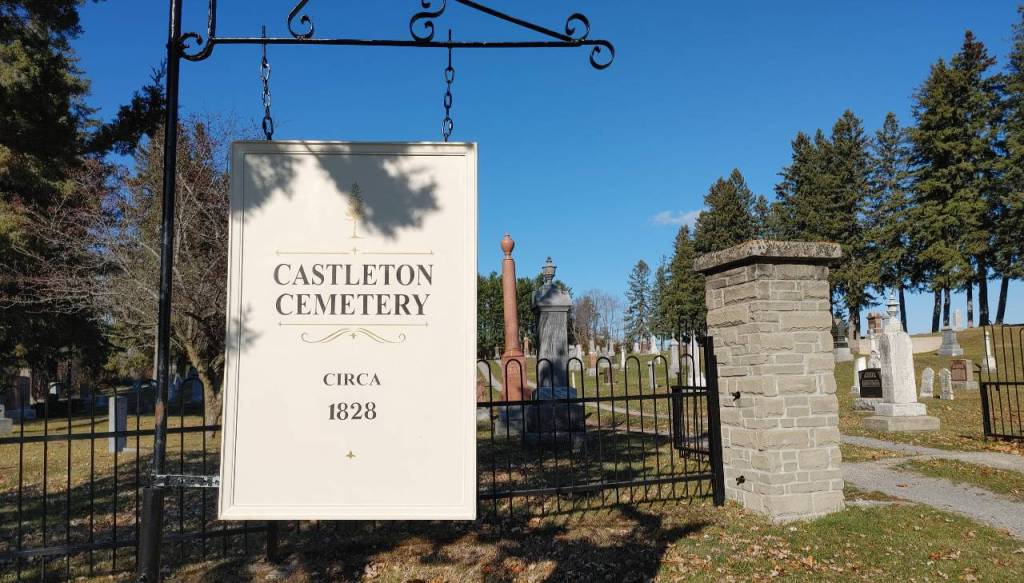
Hello dear readers, it has been a while since I have written an entry for ‘Curious Canadian Cemeteries’! Today, I’d like to discuss the Castleton Cemetery in eastern Ontario, which I visited while on a camping weekend away. This site was opened in 1828and has been in continuous use for nearly 200 years. The site features many unique gravestones and examples of conservation and restoration that I’m excited to discuss with you all.
The site is located on the traditional territories of the Haudenosaunee, Anishinabewaki, and Mississauga Indigenous peoples (Native Lands 2020). All images in this post were taken by me on November 14th, 2020.
Hi friends, it’s been too long since I’ve written a post! Hope everyone is washing their hands and staying out of large gatherings during this ol’ covid-19 outbreak we’re all dealing with. Also you don’t need that much tp, friends. Ok, since coming back from Boston in January, I’ve started a new position with a local CRM firm, TMHC, as their archaeological, cultural heritage, and social media technician! It’s been amazing so far, and I can’t wait for the field season to start! If you follow me on social media though (or, you know, read the title of this post) then you’ll know I’ve had another big thing happen in the last few months…I’ve been accepted into Memorial University of Newfoundland’s PhD program for Archaeology, which starts Sept 2020!
Yay!!
I decided I wanted to do a PhD because my favourite part of archaeology besides the excavation is the research & the writing. I really love writing up results, explaining the thoughts behind doing specific things, digging into the backgrounds, and learning about how people operated in the past. Since finishing my MA in 2017, I’ve been continuing my research and writing on my own time, published 2 papers, have been working on a manuscript, and have another project up my sleeves, along with giving some public talks and stuff….and that takes a lot of time! What better way to balance all this free work than diving back into a PhD where all this research I’m already doing can move to the forefront of my priorities? I’m really excited to focus more of my energy on this research.





 Spade & the Grave