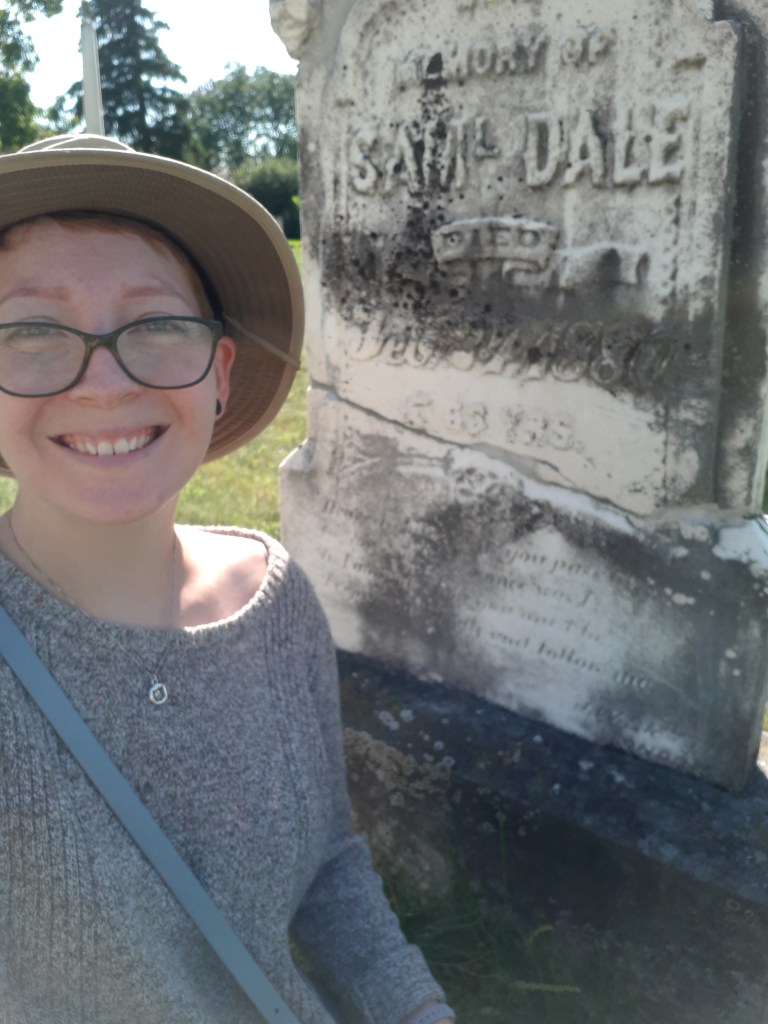
A handful of weeks ago, before the latest alert level 5 lockdown here in Newfoundland, I had the opportunity to meet with CBC contributor Andie Bulman to discuss my PhD research and our new little business, Black Cat Cemetery Preservation. It was wonderful to chat with her, and as any research knows, I loved the opportunity to talk about my research!
The article, which opens with an image of me working at Woodland Cemetery in London, Ontario in 2019, discusses my PhD research on burial grounds, concerns with gravestone conservation, and what we hope to accomplish with our (mine and my husband Ian’s) business. It’s a wonderful platform that I am so grateful to have, and I hope the message gets spread far and wide!
A photo of me in 2019, working at Brickstreet Cemetery, London, ON.
Today’s post is an extended version of the presentation I gave on twitter on January 27th, 2021, for the University of Chester Archaeology Student conference, ‘DigiDeath’. A thank you to the conference & Prof. Howard Williams for the invitation to present on my public archaeology work online. Without further adieu, my presentation! This presentation was done on twitter, so the formatting will reference that format.
Abstract: This presentation will discuss the benefits and pitfalls of utilizing digital means, such as twitter, facebook, and blogs, to disseminate gravestone documentation and conservation information. As a heritage professional and historic archaeologist, my research discussions online often brings me into direct contact with the public, volunteers who provide the majority of the restoration of historic burial grounds. I will discuss how we can utilize these channels to ensure up-to-date conservation techniques are making it to these groups, and how we can all benefit from a digital communication for conservation.
You might have seen in one of my more recent posts that I was involved in the Doors Open event in London, answering questions and giving tours of two burial grounds that I worked at over the past years: Woodland Cemetery and the Brick Street Cemetery. I’m not going to reiterate that post (though it is linked above if you wanted to check it out), but in reminiscing that even earlier this week, I found myself thinking a bit more about public archaeology of death and burial and how we interpret these topics to the public.
First thing in January I will be presenting a poster at the Society for Historical Archaeology conference with my friend Sarah that follows a little in line with this topic. Our poster is titled “In Memoriam: Challenges in Historic Burial Ground Conservation” and some of these challenges arise when information about conservation and burial grounds are adequately communicated to the public. I’ll be posting more about the poster in Jan, but it bleeds into today’s topic a little!
A view of Woodland Cemetery, Section R, facing west.
Complex monument in North Wales (photo by author, 2012)
Hello readers, many of you are being directed here via the Heritage NL gravestone conservation tips and/or by Dale Jarvis! I originally wrote this post in 2017, and have since moved back to Newfoundland and have started my PhD in Archaeology (fall 2020). I have been working in heritage for nearly a decade, and specialise in burial ground archaeology and gravestone conservation. Last summer (2019) I had the pleasure of working full time as a gravestone conservator at Woodland Cemetery in the City of London, Ontario, and have since worked with Brick Street Cemetery in London, and on some other conservation projects as a heritage consultant in the Maritimes. I have given talks on gravestone preservation best practices to a number of organisations over the last year or two, and would have happy to answer any questions you many have about a site in your area. Please contact me through my website, or at blackcatpreservation (at) gmail.com. As an archaeologist with experience and graduate degrees in Newfoundland and Labrador, I am able to be a permit holder for archaeological projects such as burial ground projects.
The purpose of this post if to inform volunteers and communities groups who are invested in the care of their local historic burial sites of the current best practices in gravestone and burial site conservation. We all know that burial sites are a vital historic resource for learning about our communities, as well as the resting places of our families and friends, and they deserve to be cared for and conserved as best we can. As an archaeologist and burial ground specialist, I hope to help you do that, and it is my goal to make the conservation techniques for ‘Do No Harm’ care as widely available as possible.
Note: I am speaking only of the conservation and archaeology of settler burial grounds, as a settler in Canada. Work with Indigenous communities in their burial spaces is another topic entirely and should never be undertaken without the express wishes and blessing of an Indigenous community.