
“Creative” writing is a good break from comps writing, right? Right. This might not be creative writing, but it’s a good flow to get those typing juices flowing while still keeping my head in the game! What is the game, you might ask? It’s gravestones. It’s always gravestones.
Today I wanted to chat to you all today about the construction of historic gravestones below the ground, getting to my archaeological roots subsurface, and how historical gravestone construction methods differ from what we see today, aka too much or too little. Let’s dig in! (hah)

There are a couple different kinds of gravestones that we are going to discuss today. Primarily, when we think of gravestones, we picture the simple tablet style headstones, constructed from a single piece of stone either set directly into the ground or into a base or ‘key’. I highly recommend taking a look at the DEBS (Discovering England’s Burial Spaces) guidance to memorial styles and terminology, linked there! It is an excellent resource and their work on standardising terminology for mortuary archaeology and cemetery surveying in Europe and North America. Other, more common contemporary grave markers are made of two or more pieces of stone, set on top of one another, either using adhesive alone or adhesive and pins.

Historically, and what we see from the 17th century onwards, when grave memorials outside of the church really become evident in the UK (later 17th century for settler burials in North America), is the simple upright tablet gravestone which extends directly into the ground. When I worked at Woodland Cemetery in London, for example, gravestones that were around 1860 or earlier typically followed this design, while later ones were set into a key. Now, there are pros and cons to each style, but I like the kind that go into the ground more, because they have less weight to them, and they have more sub-surface stability, whereas the style with the key only has a few cm’s set into that stone, which means it can more easily fall out of its base. However, they do have a wider footprint, with can mean they don’t sink as quickly. The operative word there is ‘can’.
How a gravestone sinks depends on what is going on below the surface. If the sediment and soil isn’t well packed, it could mean the stone sinks quicker. If the coffin lid deteriorates and falls in, leading to soil slumping on the surface, that can often pull the gravestone forward. If the ground is very wet, or is on a hill, or any under of variables, the ground can shift and so does the stone with it. This is totally natural!
Contemporary gravestones use a number of different methods to try and keep gravestones upright and not sinking. The most common modern (lets say 20th century) gravestone foundation is to dig a hole in the ground and, with or without a frame in the hole, pour concrete inside and set the gravestone either directly into that concrete, or use that as a flat base to stick the key and gravestone on top of. Sometimes stones are used in the bottom of the hole and we find these attached to the foundation. When I’m working to conserve a historic gravestone, this heavy concrete foundation is something that I remove if possible, as it not only weighs down the gravestone but doesn’t allow water to drain away from the more porous stone, which makes it weak and susceptible to breakage. I replace these heavy foundations with tamped limestone screening / crusher dust instead, to create a wide area to spread the weight of the stone while also allowing drainage! And, if possible, I also use MonuGrid to completely replace the concrete foundation, which creates a flexible foundation that will keep the gravestone upright and stable.

Concrete bases removed from the ground, which were replaced with screening and MonuGrid. 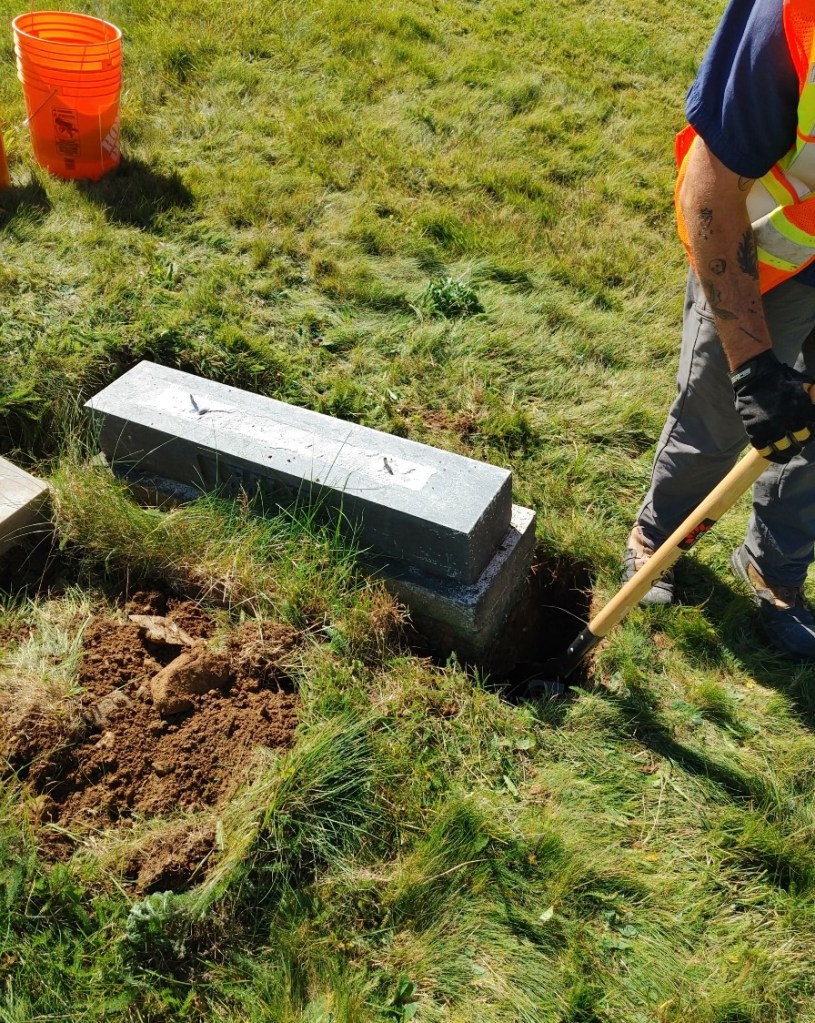
Attempting to level a gravestone base, which extended almost 2 feet below the surface. We could not move it. 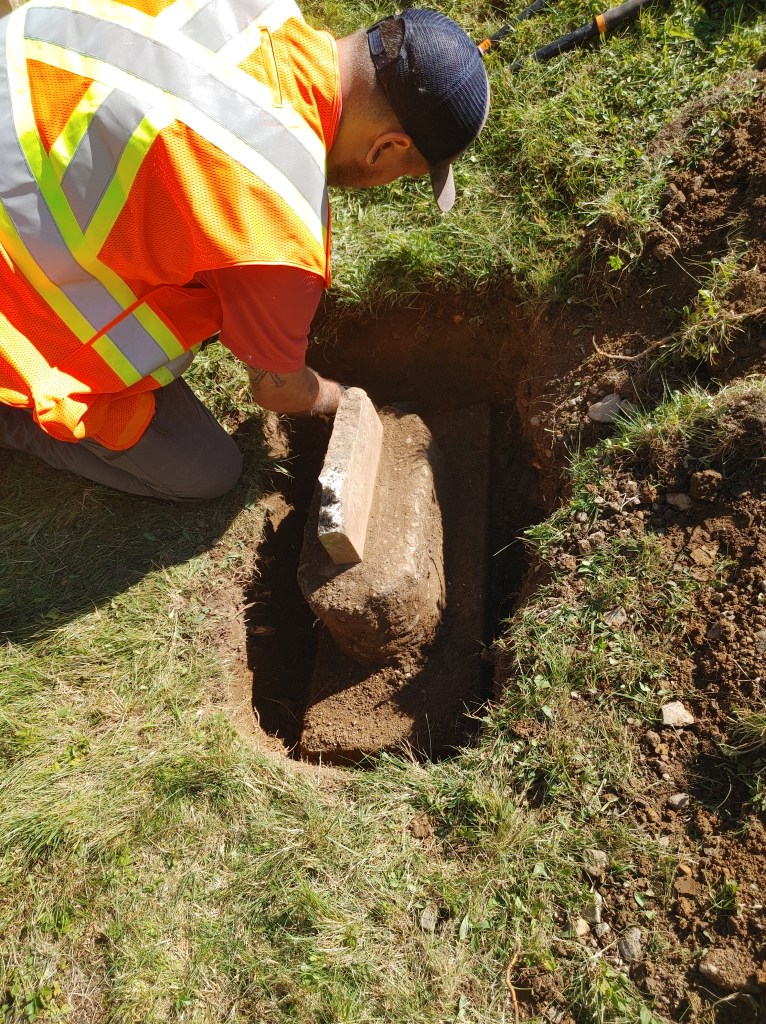
Ian working on exposing a massive replacement base, which was completely sunken below the surface.
The other method, that a client told us about on a Black Cat project the other day, is the installation of large monuments without any foundation at all. I know right? After only a few years of sitting on soft soil, the gravestone will start to sink into the grass and eventually tip over. Because most modern monuments aren’t set into the ground or keys, when the leaning monument’s adhesive gives way (in as little as a decade, sometimes) it just falls over, which can of course cause damage. This is why they need a foundation that isn’t just soil to keep them up! I just don’t recommend concrete to do that with!
In order to conserve a gravestone, it’s important to ensure that it has a nice, level foundation that isn’t going to drag the stone down into to the soil with it. Keep that in mind if you’re working with volunteers in a historic cemetery or graveyard! Also, please don’t set gravestones directly into concrete.
Ok, back to my comps. Thank you for reading!


March 1, 2023 at 11:52 am
It’s good to know that you said that to preserve a tombstone, it’s crucial to make sure it has a smooth, level base that won’t push the stone into the ground with it. I want to find a means to ensure that my father is remembered in the greatest way following his passing because he died away lately. I believe it would be appropriate for him to be able to hold people up once more because he was constantly here holding them up. I’ll be sure to bear it in mind while we look for my dad’s headstone in the future!
LikeLike
March 1, 2023 at 2:08 pm
Thank you for your comment, and I’m so sorry for your loss. A granite bench memorial stone might be a good option, he can provide people a place to rest? Granite is definitely the most durable material for modern stones 🙂
LikeLike
October 14, 2023 at 7:04 am
It’s great that my friend is planning to get a custom grave monument for her late mother’s death anniversary next month as she wants to create a meaningful tribute to honor her memory. I heard she’s been searching for a design that reflects her mom’s personality and the love they shared. I will let her know that what happens below the surface affects how a tombstone lowers because unconsolidated silt and loose soil may lead the stone to sink more quickly.
LikeLike
February 6, 2024 at 6:08 pm
We just lost our grandma the other day and we’re still reeling from the pain and loss of it all. However, we’re thinking of getting her the best custom stonework that will reflect her character. So, thanks for talking about how digging a hole in the earth, filling it with concrete (with or without a frame), and setting the gravestone either directly into the concrete or using it as a level surface to place the gravestone and key on top of is the most popular method of laying a gravestone foundation in the modern era.
LikeLike
February 6, 2024 at 8:06 pm
I’m so sorry for your loss!
I wouldn’t set the gravestone directly into the concrete, that will make it impossible or very difficult to reset if needed later. I discussed in my post how that method isn’t good for conservation. I definitely recommend gravel and monugrid or another membrane system 🙂
LikeLike