
This past weekend, myself and my husband traveled over to Windsor, Nova Scotia, to visit our friends and tour around a couple of the local burial grounds…because what else would we be doing on the weekend? We’d been informed that some conservation efforts had been undertaken at the oldest site in the town, the Old Parish Burying Ground, and based on the photos there was some concern over how that conservation had been carried out. So we wanted to document what we could, and see the amazing gravestones as well (There will be a follow up post on what we found, because it’s very exciting!).
The Old Parish Burying Ground was opened in 1776 according to the sign at the front of the site. The Canada’s Historic Places page (Click HERE) gives some confusing dates and, I think, a typo at the beginning of the page claiming the land was given to the church in 1779, but lists the opening date as 1776. It was the site of the first Anglican Church in Windsor, but the site itself was not consecrated until 1826, by Right Reverend John Inglis. This was a common occurrence in Newfoundland and Labrador, when Bishop Inglis would travel to outports for services and consecration of sites. His name appears a lot in records of NL burial sites, so it was very familiar to come across his name here too!
Content warning: Upsetting gravestone repairs using incompatible materials
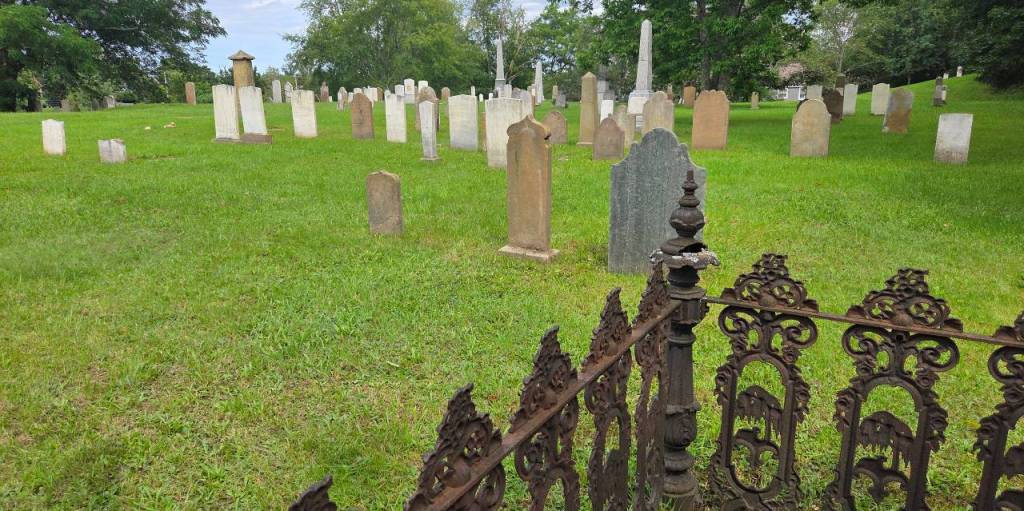
The church on the site burned down in 1892 and was not reconstructed because another church had recently been completed nearby in 1884, the same year the site was closed to burials. When we arrived at the site, we entered via the stairs off King Street. There is a sign with the site dates on it, and another showing the municipal designation of the burial ground. In other words, it is a pretty significant site.
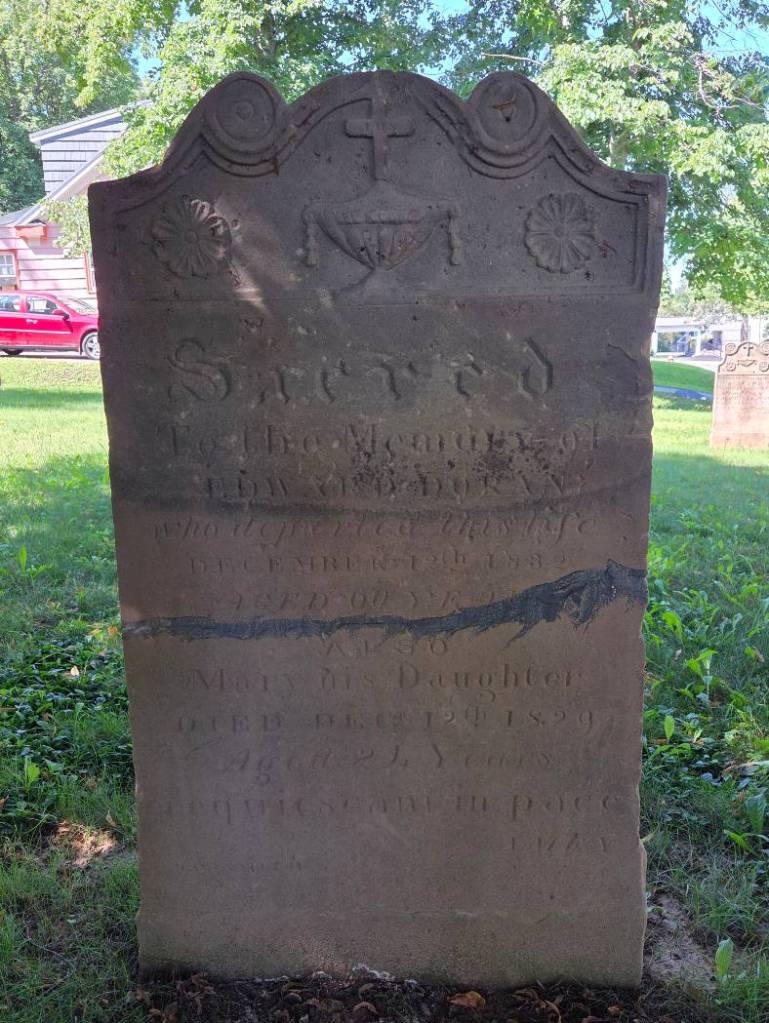
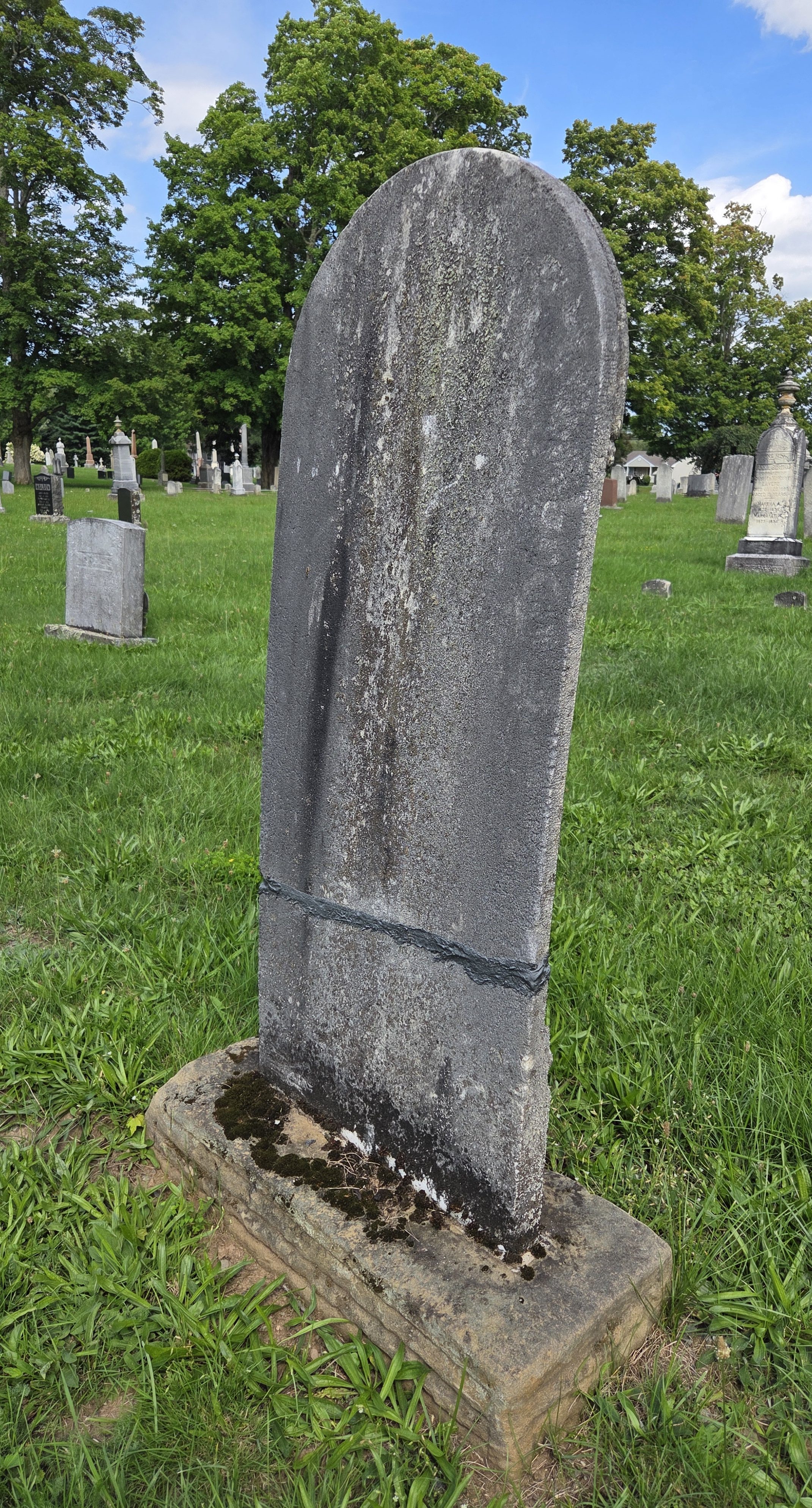
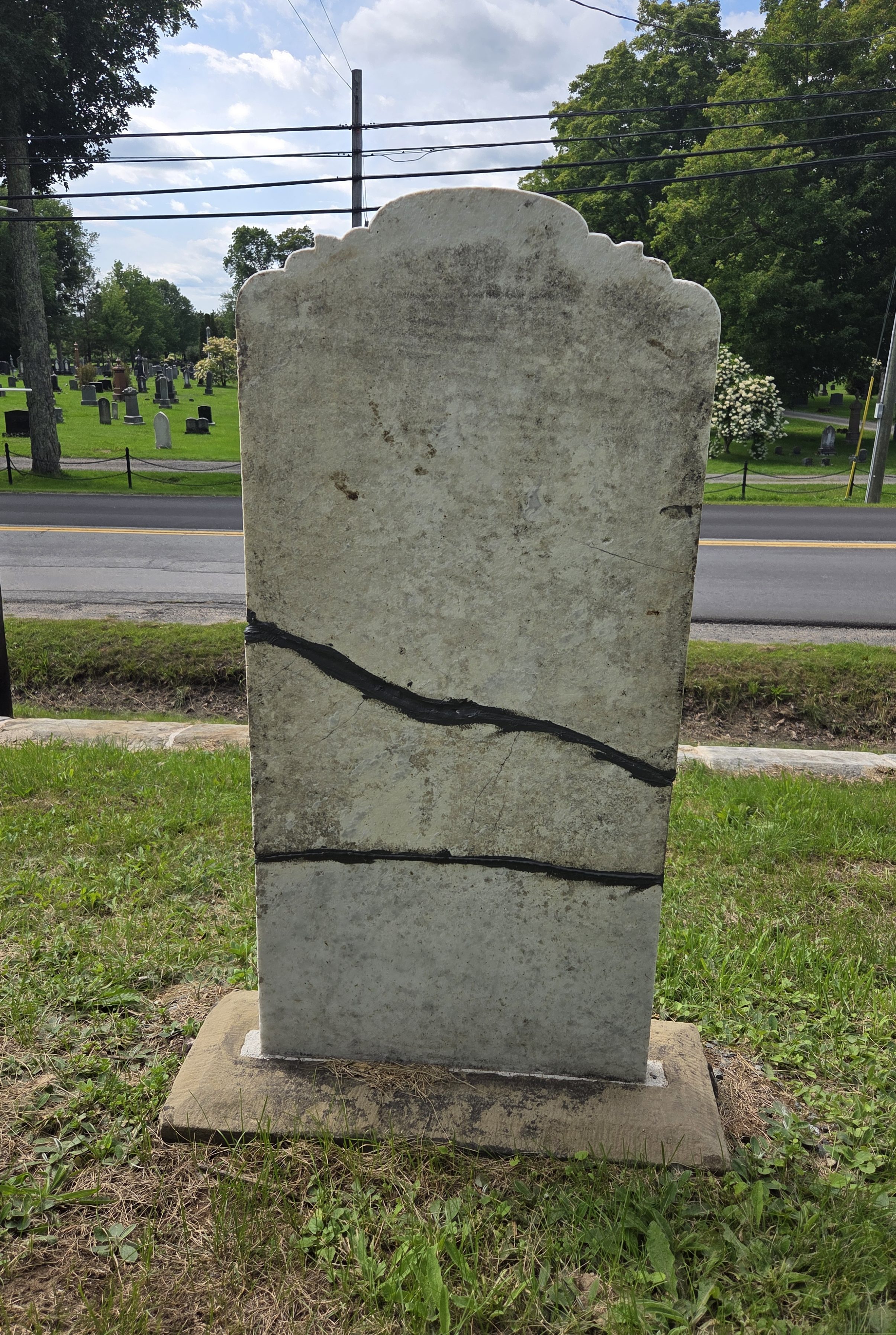
Unfortunately, this is where the conservation problems start. We observed some of the company’s work at the two other burial sites we visited the same day and were already pretty apprehensive for the damage we were about to see. At the other sites, a couple of stones had been glued back together with an extremely hard, dark grey adhesive. I know the colour and feel of it, because not only was it visible from the exterior but it was smeared all around the breaks on the surface of the gravestones. I’m not saying this to be dramatic, this is exactly what happened. A friend said it looked like PL 400 Construction adhesive, which she used to fix concrete patio blocks. In other words, not something that should be used on historic stonework in any circumstance.
Before we go any further, let me give you the link to a post I did a while ago on the Do’s and Don’ts of Gravestone Conservation (HERE). It just touches on the basics, and I did write the post in 2017, updated in 2019, but I keep an eye on it in case any techniques change.
The company responsible for this work at the Old Parish Burying Ground was hired by West Hants Regional Municipality. It appears to have been a several-season contract, and I don’t know if the worked on all of the stones at the site, but it seems like ones that weren’t repaired were cleaned at the very least. We are in the process of bringing these conservation issues to the attention of the heritage society and the municipality in the area.
So why is this adhesive a problem? Aside from being the wrong colour and covering the inscription on many of the gravestones, it is not a conservation adhesive. We don’t know if its a UV-stable material, which means it could degrade with exposure to sun. We don’t know how temperature stable it is, which means it could crack with heat and cold under expansion. Also, when applying an adhesive to a gravestone to repair a break like these stones have (most of these stones are considered ‘simple tablet’ gravestones), it is considered best practice by heritage professionals, myself included, to only apply the adhesive in small dots. This ensures that you are not creating an impermeable layer of glue that moisture cannot move through. Small dots of a stone epoxy used for conservation mean that there are still areas of stone on stone, so moisture absorbed into the gravestone doesn’t collect anywhere specific.
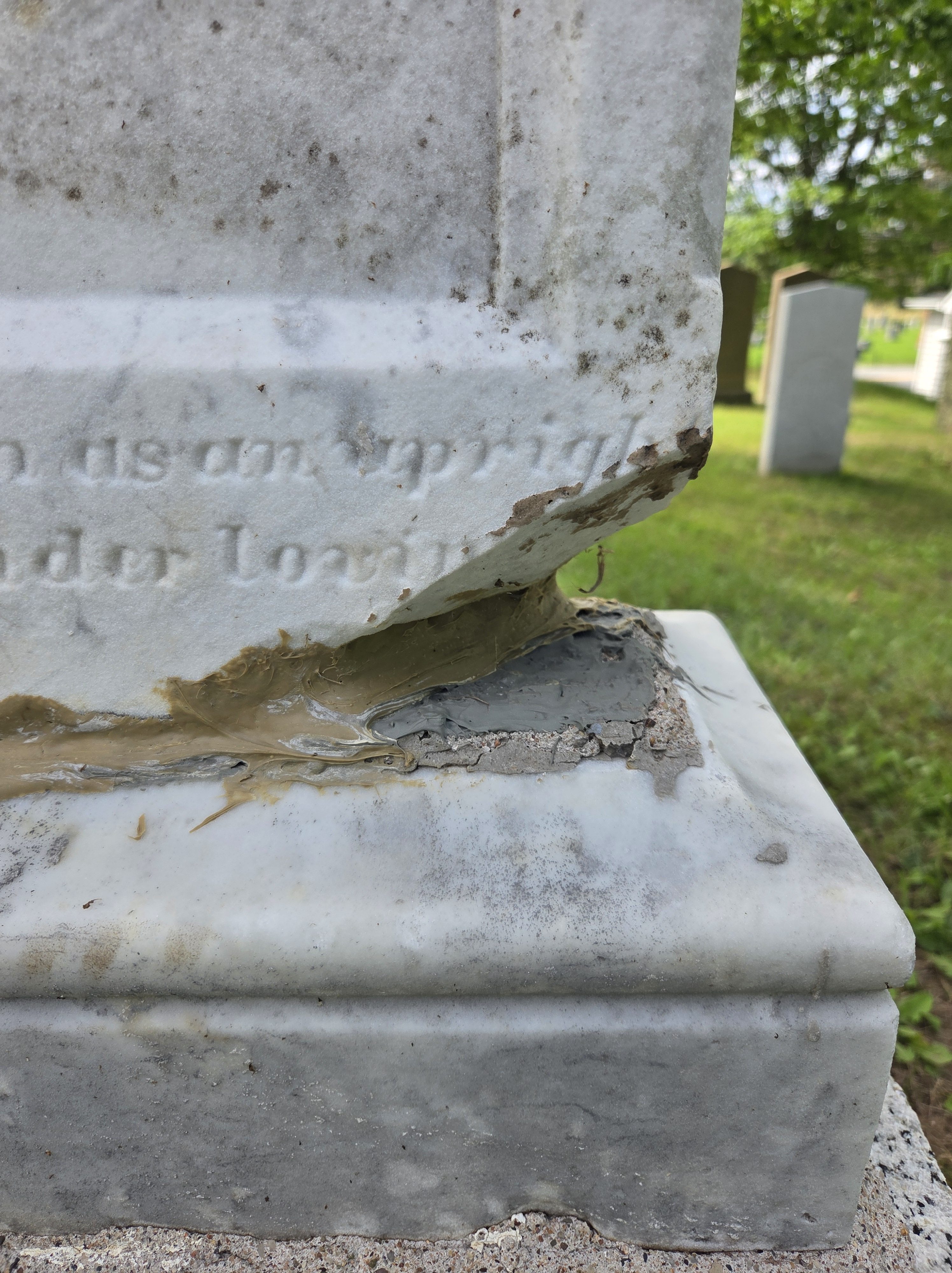
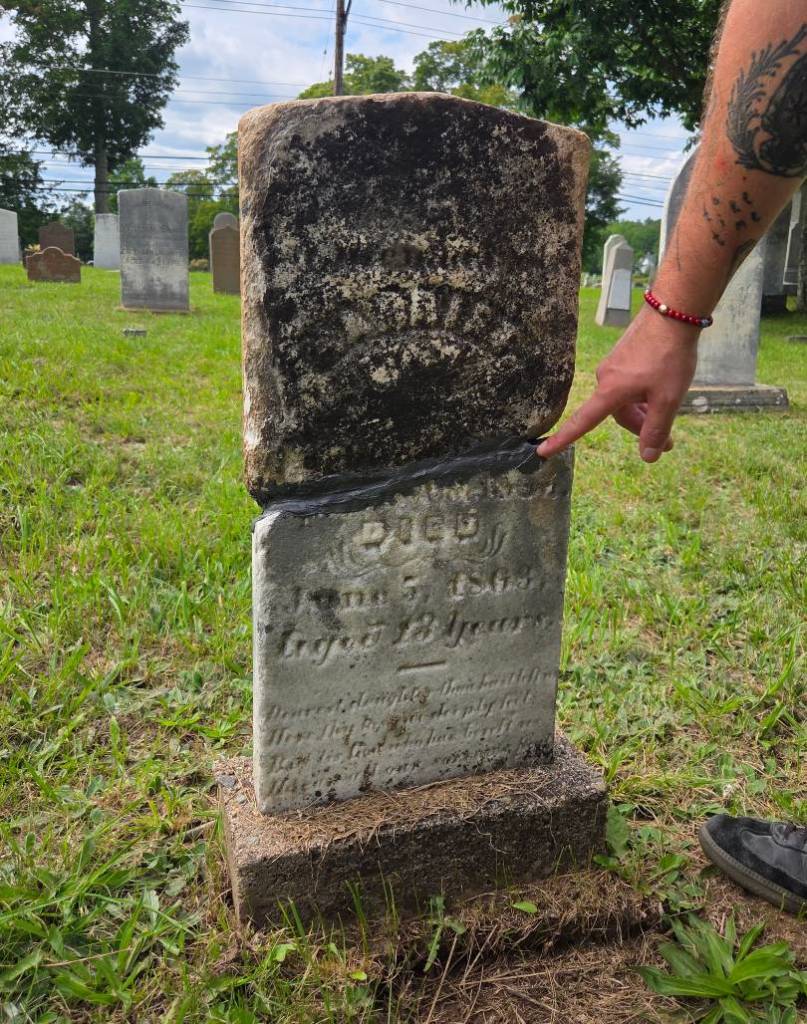
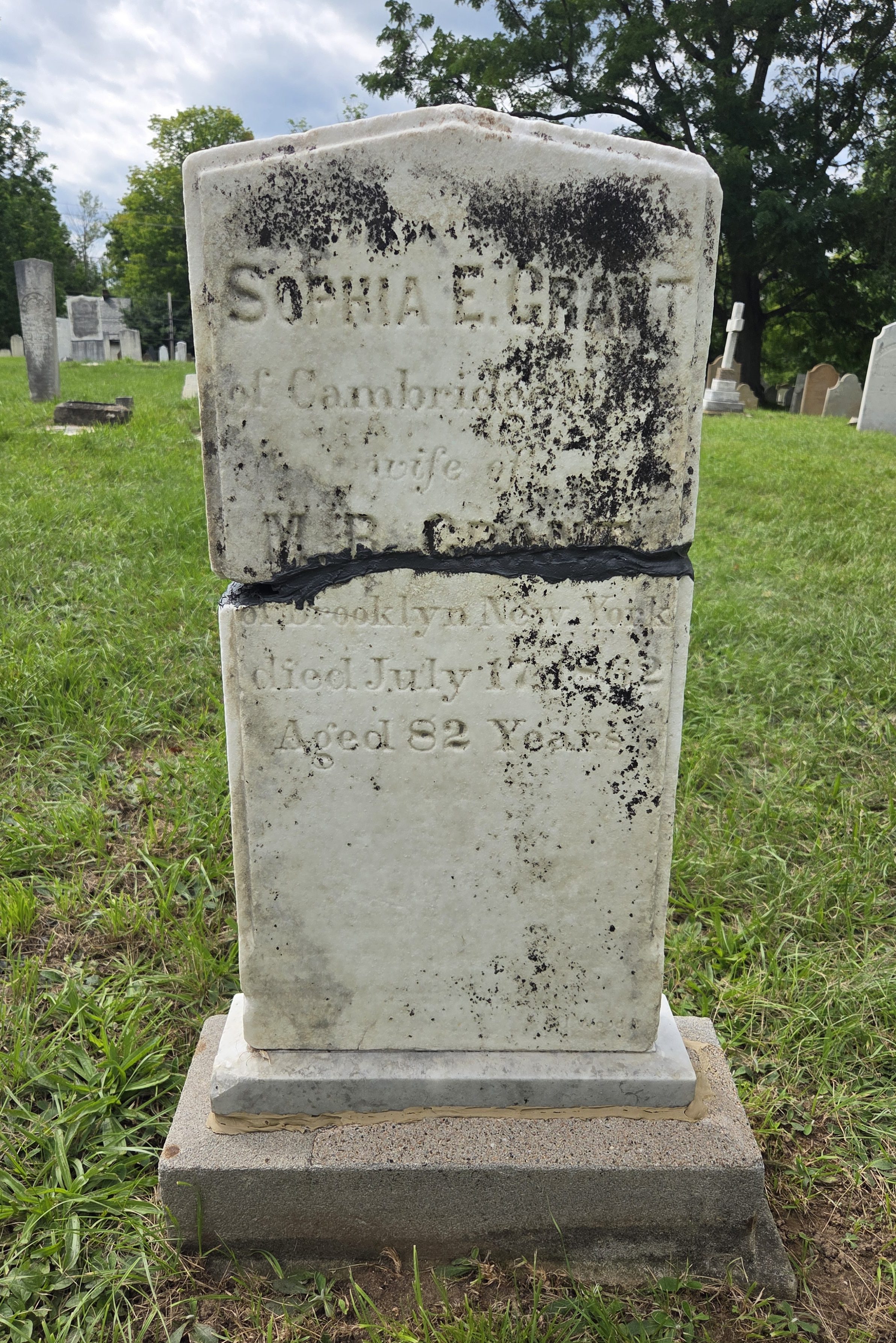
Additionally, you should not be able to see the adhesive. Conservation should be sympathetic to the artifact, in this case the gravestone, and while there are two camps on repair or restoration work (you should either be able to see it clearly as a repair even though its compatible, or not see it at all), it should not be so obviously that the repair materials is a completely different colour from the original material itself. For gravestones, you should not see the adhesive, and the infill of the broken area should be done with a gentle material, preferably a pure lime mortar. Lime mortar allows moisture to wick away from the stone and evaporate, greatly prolonging the life of the stonework. This it the reason that historic stone buildings made with lime mortar and not concrete have stood for 1000 years in Europe, because the stones can actually breathe.
The use of this black/grey/putty coloured adhesive on soft sandstone and marble gravestones may be sticking them together but is going to do longterm damage to the stones. Not only that, but I can guarantee that it would be extremely difficult to remove that material without damaging the gravestones too. Good conservation should be reversible, and this is absolutely not the case here.
Additionally, when I contacted the company involved with this work to ask what their cleaning process was, they informed me that simply scrub the stones with soap and then power wash them. If you’ve been around gravestone conservation for a hot minute, you’ll know that power washing strips the surface of the gravestone straight off. Sure it looks clean for a while, because you’ve literally removed the surface of the gravestone and its various stains. This makes the stone way more susceptible to weathering, and will cause the gravestone to deteriorate faster. In short, it only speeds up the process of the stone falling apart. Soap also deposits salts and/ or acids, depending on what they used, into the pores of the stone. Salts expand in there, breaking the surface. Acids eat away at the softer parts of the stone, breaking it down and causing loss of particulates (like the grains). Cleaning should only be done with water, a soft plastic or natural bristle brush (tampico, horse hair, etc), and a biological cleaning agent like D2 Biological Solutions. Rinse with a bucket, a spray bottle, or a hand pump sprayer, but never a pressure washer.
As you can probably tell by this post, I’m upset. This work was done by people who claim to restore gravestones but are doing so in a way that is causing way more damage in the long run, and that the work was supported by groups in the area. Maybe people didn’t know any better, but there are way more accurate resources online from reputable sources that it isn’t hard to come across someone like me, yelling into the ethernet that soap is dangerous from gravestones. Conservation is an evolving science, and should be undertaken by people who have had training, and who keep up to date on the field enough to know what will cause damage, and what will be reversible if a new study brings new information to light and something needs to be changed.
There were some things done that we liked at the Burying Ground, which was stones that were no longer able to be stood upright were set into a bed of gravel on the ground, laying flat. This allows for drainage underneath the stone, while also keeping it from sinking immediately into the dirt as they so often like to do. This is how we reset stones that are too broken or degraded to reset to standing, at a slight angle to keep water from pooling on the surface. It was great to see that option being used, but if those stones were also washed with household soap and power washed, then they are not as safe as I hoped when we saw them at the site.
Basically, if these gravestones had been left alone, they would be in a better state than what is going to happen as the result of these repairs and cleaning work. More due diligence needs to be carried out when dealing with heritage sites likes these, and I wish there were better regulations for historic burial grounds which would connect people with archaeologists who might know more, and be able to guide a heritage society or municipality to people with training, or help them learn what best practices are today.


Pingback: This week's crème de la crème - September 12, 2026 - Genealogy à la carteGenealogy à la carte
September 12, 2026 at 12:51 pm
What a shame. Wouldn’t you think after the first couple of poor results, “somebody” involved in hiring a company doing such a bad job would put a halt on it or at the very least, question the negative outcome ?
I have a great gran buried in one of the Foxtrap cemeteries in the Conception Bay South area, Newfoundland …… who’s gravestone is in such sad shape currently. Back in 2007 I made my one & only visit. Thank goodness I took photos because, since then, it has deteriorated with a vengiance …………. thanks to mother nature & someone deciding to deliniate the inscription with a black marker & someone adding globs of adhesive.
Keep talking out loud. Maybe one cemetery, somewhere, will be put on alert & dig a little deeper/ do a little more due diligence before committing.
TONI
LikeLike
September 12, 2026 at 8:14 pm
Hi Toni,
I’m pretty sure they think these are good repairs, which is really what’s frustrating!
I’m glad you were able to document your relative’s gravestone, that’s the so important! So sorry to hear that someone tried to add to the stone. If you ever want us to try and clean it, reach out!
LikeLiked by 1 person