
I suppose I can’t start off every post by apologising for not writing forever, but it has been nearly 6 months so I suppose I’d better do it this time. Sorry, friends! Life has been going fast and I have a lot of projects on the go at the moment, both at work and on my own time, so writing a research blog for fun has been pushed to the side. However! I’m in the middle of writing my next book project, ‘A Graveyard Guide to Eastern Newfoundland’ (tentative title, does anyone have anything snappier??), and I got sucked into a research rabbit hole last night for several hours writing about a specific gravestone, so I wanted to share that excitement with everyone!
Harbour Main is a small outport community on the south coast of Conception Bay, Newfoundland and Labrador. It is well known for its gorgeous beach called ‘The Tide’, but it’s known mostly to me for being home to a small early cemetery that my friend Katie took me to see back in 2021. At this site, called The Old Irish Cemetery or the Old Irish Roman Catholic Cemetery, there are a number of field stones and other locally carved markers, but one in particular has stuck in my mind, because it’s inscribed in French.

The Gravestone
The gravestone in question is carved from a local stone, possibly a sandstone or slate (I haven’t been out to see it in person in a long time and don’t remember the texture!), and features a small cross with even shaft and arms, with serifs, under a stylised archway. It was not carved professionally, but by someone who did seem to know what they were doing, with guidelines to help organize the letters still visible on the surface. Amazing craftsmanship, really!
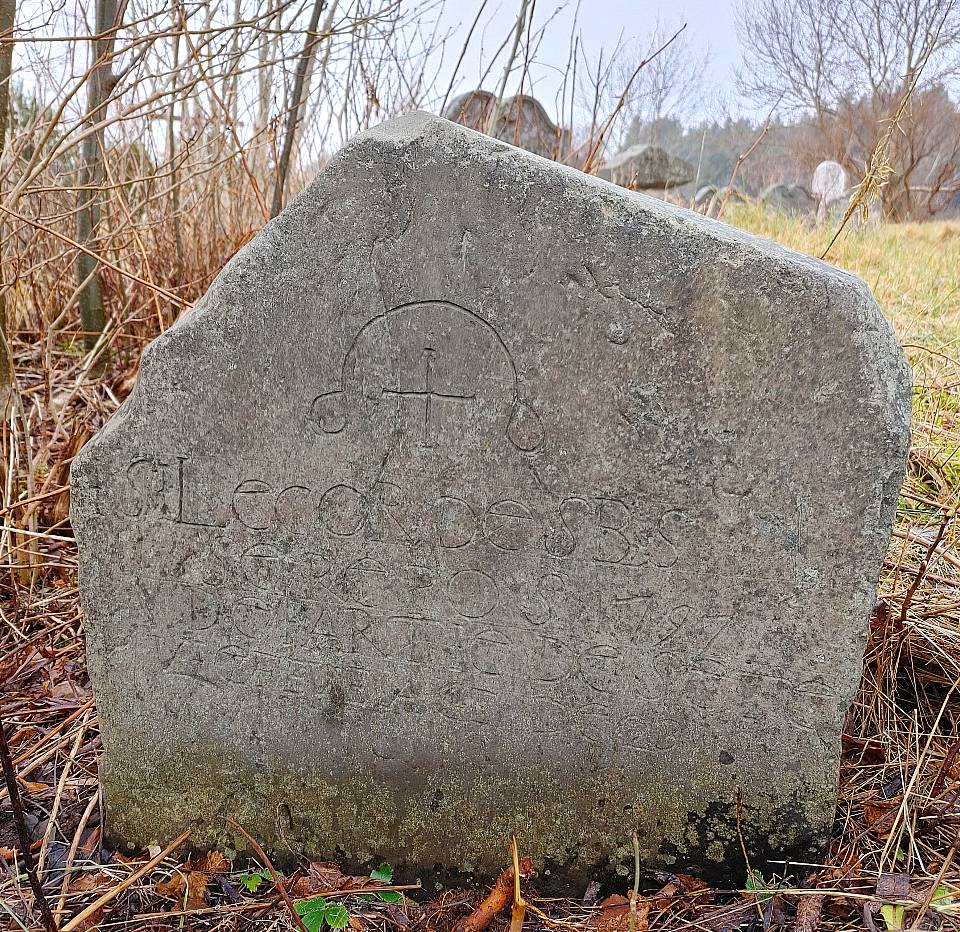
The inscription reads:
“ISI LECOR DE SBS
SE REPOS 1797
DEPARTIE DE SETE
VIE FEVE AGE DE 23″
Interestingly, all of the letters are written as capitals except for the E’s on the top 3 lines. When we get to line 4, after VIE the lines are written as standard capital E’s. Now, I don’t speak French and my translation skills are mediocre, so I enlisted the hive-mind of academic Bluesky & my new friend Solene! Lets discuss some of the translation options, because the last line is cause for some confusion, and there is not enough room in my guidebook write-up to fit in all this information! Consider this a bonus to that entry!
Potential Translations
1. Line one. The most common interpretation I’ve seen of this gravestone comes from records on BillionGraves and FindAGrave, both crowdsourced gravestone recording websites, and an article in the French-language Newfoundland and Labrador newspaper ‘La Gaboteur’ interviewing HeritageNL staff from January 2021. I’ll link these resources below for your reference. These resources all list the individual’s name as I.S.I. LECOR or I.S. LECOR. It is suggested in the article (Broderick 2021) that last name is Lecor, or Lecour, as is evidenced by other families in the Harbour Main area having that last name. If this were the case, then the stone suggests that they came from a place abbreviated to SBS. Dale Jarvis suggests that this could be ‘Saint-Brélade’ (Broderick 2021), as does the FindAGrave entry.
However, when I took a look at the gravestone inscription and brought it to my friends on Bluesky, they pointed out something else. ISI LECOR is an abbreviated way to write a common opening line to a gravestone epitaph in the 18th century – ‘Ici est le corps/ici le corps’ for ‘Here lies the body of’, or more literally, ‘here is the corpse…’. The way the grammar was explained to me, if you started with the idea that the person’s name was Lecor, the rest of the first sentence doesn’t make sense (merci Solene). With this in mind, the first line reads ‘Here lies the body of SBS’, leave the person’s name as only initials.

2. The second line, ‘SE REPOS 1797’ is pretty straight forward it seems. Everyone has translated it as ‘died/passed in 1797’. The numerals do appear to have been added by a different hand, or later, which is interesting also. They don’t seem quite as orderly, but maybe the carver wasn’t as good at numbers.
3. The third line, ‘DEPARTIE DE SETE’ is pretty interesting. The common consensus seems to be ‘Departed this / left this’. SETE is likely a phonetic spelling of ‘cette’ meaning ‘this’ in English. Several people have informed me that the individual carving this stone was terrible at spelling. The spelling also might not have been standardised at this point in history, as much of the English language had variable spellings as well. I think we can all agree on this line’s meaning, but another interesting thing was pointed out by another Bluesky user that ‘Departie’ would be the feminine usage of departed/left. If this is the case, SBS might be a woman.
4. Line 4 is the most confusing line. Reading ‘VIE FEVE AGE DE 23’, there are a few potential things going on here. VIE is life, and most people seem to agree on that one (including me, with my minimal French). Someone suggested that the capital I with the dash through it indicates a work broken between lines, but I don’t agree with that suggestion, as you can see the rest of the I’s in this inscription are carved the same way, using an archaic style of lettering. FEVE is the word that is really throwing us all off, and there are a few options for what it could be!
- FEVE = a short form for février, or ‘February’. If this is the case, and we know the carver was using short forms of other words, the line would read ‘…life February Age of 23’. A bit awkward, but plausible. This is also information that is often included on gravestones too.
- FEVE = a short form of fièvre, or ‘fever’. If this is the case, the line would read ‘life of fever age of 23’. This also makes sense. Gravestones sometimes do list the cause of death of the individual. Supposing SBS is a woman and died at 23 of fever, this could have been brought on by childbirth. It’s a stretch without more information about the person, but also plausible.
- FEVE = the V is being used instead of a capital U, to spell ‘feue’, an old French word that roughly means someone’s recent death. I wish there was another work with a U in the inscription to compare against, because using a V in place of a U is a very Very old fashioned choice (like..Latin/Romanesque), and it would be good to make sure. But if they were doing this, and it is indeed feue, the line would indicate something like ‘leaving [her?] life recently age of 23’. Grammatically, I’ve been informed that is very awkward as well. If the word is feue though, it is also in the feminine (feu), and would again suggest that SBS is a woman, which is cool.
So the translation of the 4th line could be ‘life February Age of 23’, ‘life of fever, age of 23’, or ‘recently passed at the age of 23’. It’s very difficult to tell when the carver took so many liberties with spelling and abbreviations throughout the stone, so we may never know, unless we can track down some burial records from Harbour Main in the late 1790s! An alternative translation that is more poetic was suggested as ‘meeting her fate aged 23’, which is lovely. It would be equally as great if it said the month or mode of death!
Conclusions
In 1797 in the town of Harbour Main, a French-speaking person died at the young age of 23, and was buried below a gravestone carved in their native language. Was the carver someone who even knew French? Was this person a visitor on a fishing boat or merchant ship, or had they moved to the area? Was this a sailor, or a young woman who may have died in childbirth? I’m going to keep looking into this, but for now we don’t know everything.
“Here lies the body of SBS
Died 1797
Departed this
life [of fever] [February] [recently] aged 23″
For now, this is all we have, and what an interesting story is already is! Thank you to my friends on Bluesky for helping me with this research last night, it was such an interesting thread to follow!
References
Billion Graves. nd. ‘Old Irish Cemetery’. Billion Grave. Website: https://billiongraves.com/cemetery/Old-Irish-Cemetery-/335158
Broderick, Cody. 2021. ‘Décryptage d’une pierre tombale à Harbour Main’. La Gaboteur, 25 January, 2021. Available online: chrome-extension://efaidnbmnnnibpcajpcglclefindmkaj/https://heritagenl.ca/wp-content/uploads/2023/07/2021-Gaboteur_37.08_25janvier2021_11.pdf
Find A Grave. nd. ‘I.D. Lecor’. Find A Grave. Website: https://www.findagrave.com/memorial/269858308/i-s-lecor

 Spade & the Grave