
Hello readers! It has been a wild last few months with my defence, dissertation edits, submitting my final dissertation (convocation next month!) and a sprinkling of fieldwork. I’m excited to get back to a bit of writing on here, and bring you all some interesting mortuary archaeology pieces! Today, I’m excited to finally be sitting down to write a bit about our recent trip to Scotland with my parents, and all the amazing burial traditions we learned about while there.
We (my husband and I) travelled to Edinburgh to meet up with my parents, who had gone over a few days before us to explore the city. The joke for the entire trip was that we were only going to look at old stuff and birds, as a group of two archaeologists and two birders who also like history! And look at old stuff and birds we did! I also dragged everyone into every chambered burial cairn we came across, and we all brought headlamps on the trip for just that reason. It was amazing, lets get into it!

After leaving Edinburgh, the first stop of the trip was a week in Shetland. The Shetland Islands are the most northern part of the UK, accessible via plane or a 15 hr ferry ride from Aberdeen to the main city of Lerwick. We took the ferry and the water was glass the entire way up, we had an amazing journey! Shetland was such a stunning landscape to experience, with its rolling hills covered in heather and low plants, and sheep absolutely everywhere. The islands (Shetland and Orkney) were part of Norway from the 10th century til the15th century when the were given to the UK as part of a dowry payment for Princess Margaret’s marriage to King James III of England. As a result of their ties to Norway and their remote location, the Romans never made it to the islands, meaning the ‘long’ Iron Age from around 600-400 BCE lasted until about 700 CE when the Norse (Vikings) arrived. You can still see a lot of the Norse influence on the culture and dialects!
One of the first things we noticed in the first graveyard we visited in the village of Walls, where we were staying, was this very ingenious way of stabilising gravestones that were in need of conservation work. The markers that were at risk of falling had a wood frame built around them to lean on, without putting any metal in contact with the stone itself, which would lead to staining. The angled posts were then attached to posts driven into the ground away from the stone to give support in the direction it was leaning. Each one of these markers had a little tags on the site, or on the ground in front, which read,
“Shetland Islands Council Burial Services, Important Safety Notice: This memorial has failed a regulatory test and in considered unstable. Please Do Not touch or approach the memorial”

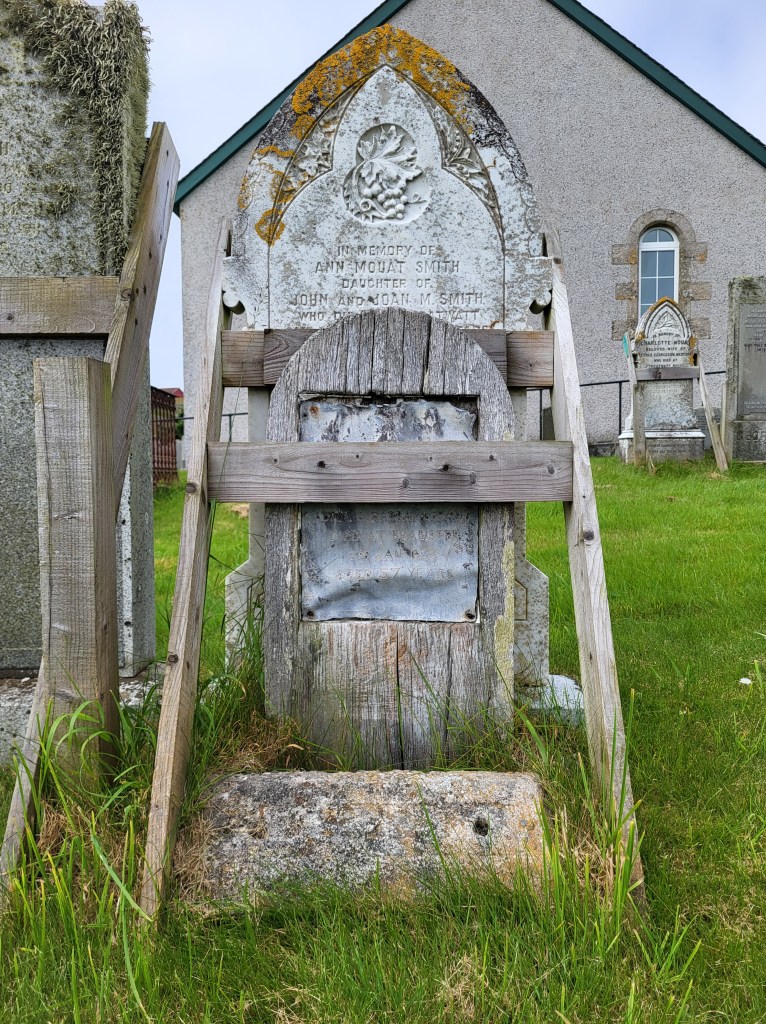
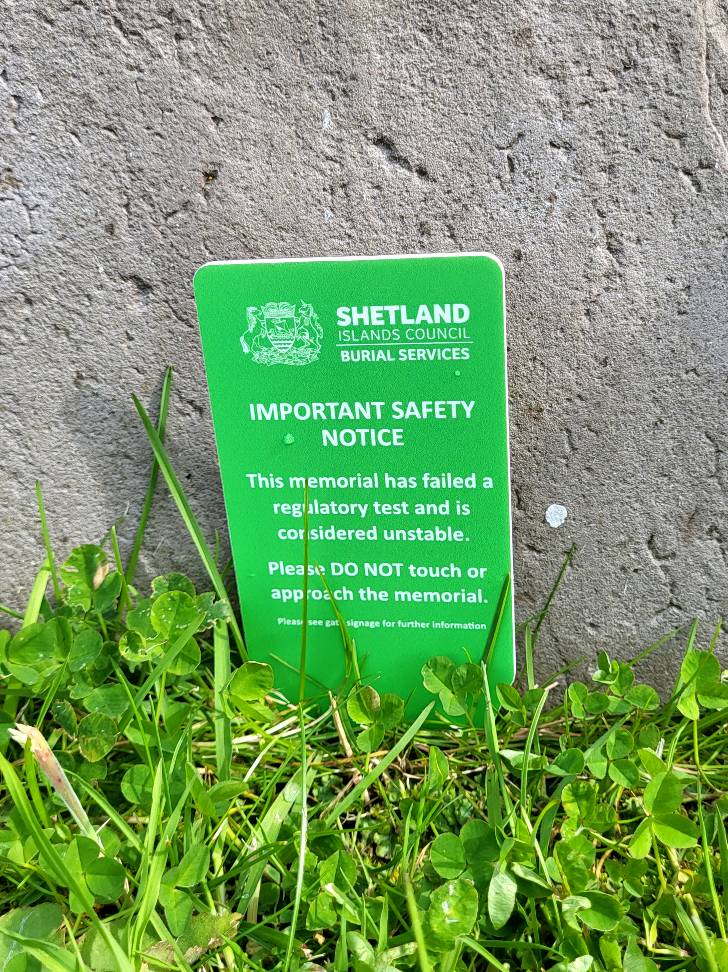
How amazing is that? The Shetland Islands Council has a burial services section, which personally I would love to learn some more about, especially about how they work with all the historic burials on the islands. They regularly check old monuments for safety, and install these signs and frames to support stones and protect visitors until such time the monument can be repaired. It’s really cool, and inspiring to see a local government taking initiative to work with parishes and protect their historic monuments. I love it!
On the 9th day of our trip, we all woke up super early to drive across Mainland, take two ferries, and arrive on the island of Unst, the most northern inhabited island of the Shetlands and all of the UK. It was gorgeous, and has tons of Norse sites scattered across the island. We hiked in the Hermaness Nature Preserve (didn’t quite make it to the lighthouse, so we’ll have to go back), and visited St. Olaf’s Kirk at Lund. This was a site I had flagged on google maps as a potentially interesting spot, but I have no idea how cool it was going to be! To access the site you have to drive through several gates on a sheep farm, opening and closing each one behind the car. There were the ruins of a croft, Norse longhouse depressions in a field, and finally a long road down towards a sandy crescent-shaped beach and the ruins of a 12th-century chapel!


The chapel itself no longer has a roof and has several burials inside the walls, including a German marker from the 16th century written in Low German, and a Pictish pre-Christian carved stone of a snake or a serpent reused as one of the window lintels. It was amazing to see! My favourite part were the six early medieval cross stones around the exterior of the church, marking early burials within the perimeter of the original churchyard. Some reading that evening told us that the stones were all made from local material and likely dated to the 9th-12th Century, which means they likely predate the present church structure!
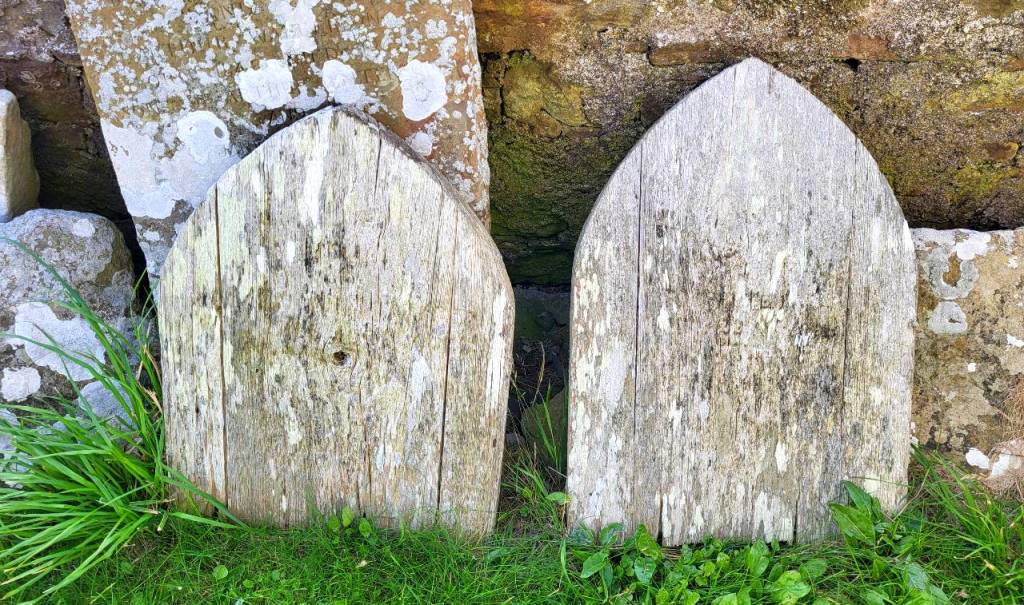
We also had the chance to visit multiple graveyards that had a number of wooden grave markers in various states of preservation. I cannot remember where this particular photo was from, possibly a church on Orkney, but we were lucky enough to see wood markers on Shetland as well. The photo in the photo are fairly plain in shape, and would have been painted with the information about the individual, which has long since worn away. Wooden grave markers would have been a cheaper option than stone, though Orkney and Shetland both have very few trees, so even having a small marker made from wood might have been expensive. Certainly more expensive than a simple fieldstone. It was lovely to see well preserved examples of wooden markers, as the majority of the ones in Nfld have rotted away.
The highlight of burial archaeology once we got to Orkney was the chambered burial cairns that dot the islands. I had everyone pack a headlamp because I was fully planning to haul my family members into as many holes in the ground as possible. Historic Environment Scotland has done an amazing job preserving and caring for these sites, the majority of which you can visit free of charge, as long as you are prepared to clamber around dark passageways. We managed to visit a good number of these tombs, which were built during the Neothlic Period on Orkney, approximately 5000 years ago. The structures inside the cairns typically include a central chamber with a corbelled roof, as the Neolithic people did not know how to build an arch yet, and a series of smaller side chambers. They were entered through a long entry tunnel, some of which were over 5m long and could only be entered by crawling. These tombs were built into the side of a hill or on a prominent piece of land.

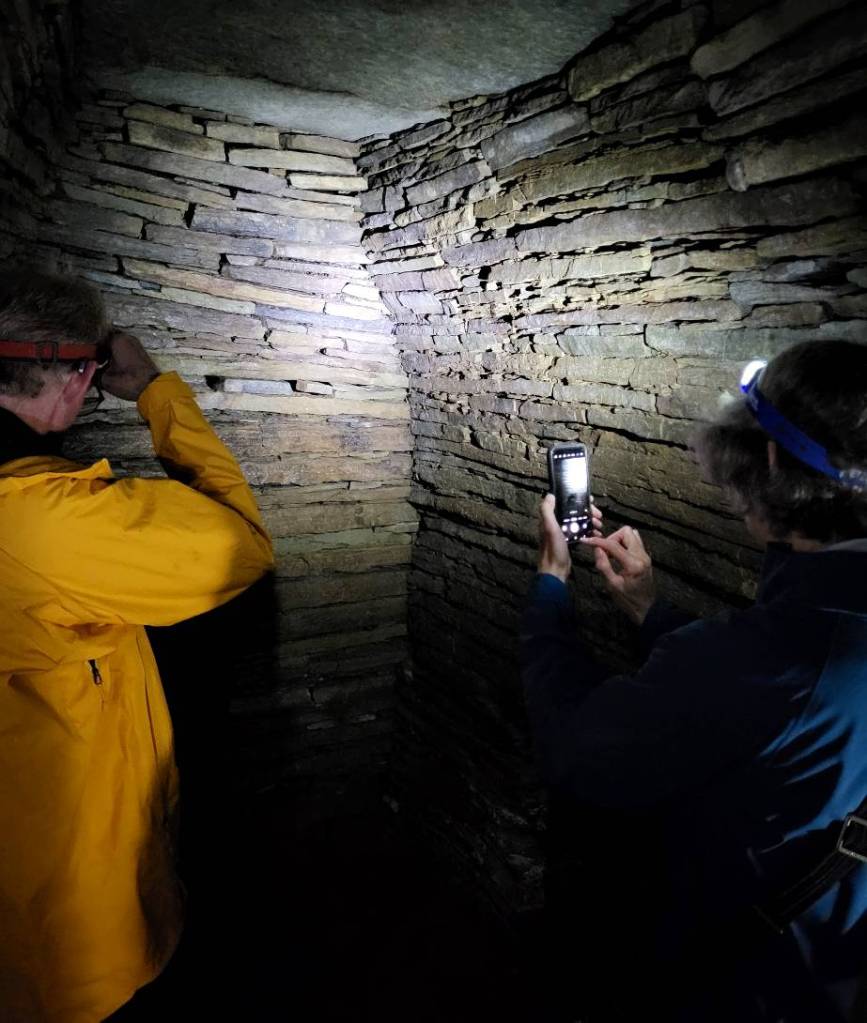
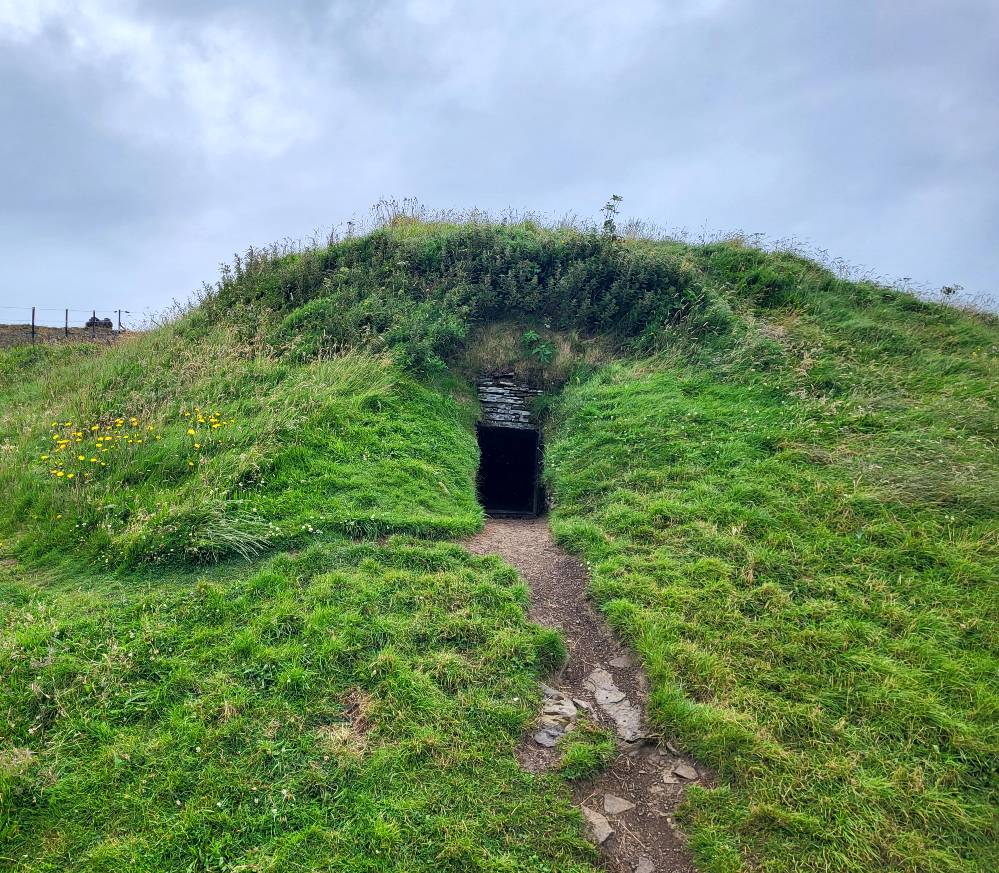
We were able to visit Unstan Chambered Cairn, Cuween Chambered Cairn, Wideford Hill Chambered Cairn (pictured at the top of this post), and had a guided tour of Maeshowe Chambered Cairn! We were hoping to visit several sites on the island of Rousay as well, but unfortunately the ferry schedules didn’t line up with our plans this time around. Next trip! Cuween Chambered Cairn was very interesting, as there were only a few sets of human remains found inside, but the remains of over 20 domestic dogs! This really demonstrated the importance of dogs to these people, even 5000 years ago. Amazing! This tomb was also accessed by a very low, very long entryway, and was cut into the side of a hill!

Visiting the Wideford Hill Chambered Cairn was really interesting. We discovered that rather than the long hike up and over the hill to the cairn, Historic Environment Scotland maintained a trail the skirted the edge of the hill and offered gorgeous views over the farms. The entrance to the Wideford cairn was way too small to allow visitors to clamber through, so today the tomb is accessed through a hatch in the roof and down a very narrow ladder into the small central chamber. The sign claimed there are examples of Neolithic ‘scratch’ art inside, but did not point out specifically which scratches they were. I’d like to think we managed to see them!
I don’t have photos of Maeshowe, as they do not allow photos inside, but I highly recommend looking up pics of the interior or even booking a tour if you are visiting Orkney! It is the best preserved chambered cairn on Orkney, and is part of the ‘Heart of Neolithic Orkney’ UNESCO World Heritage Site.
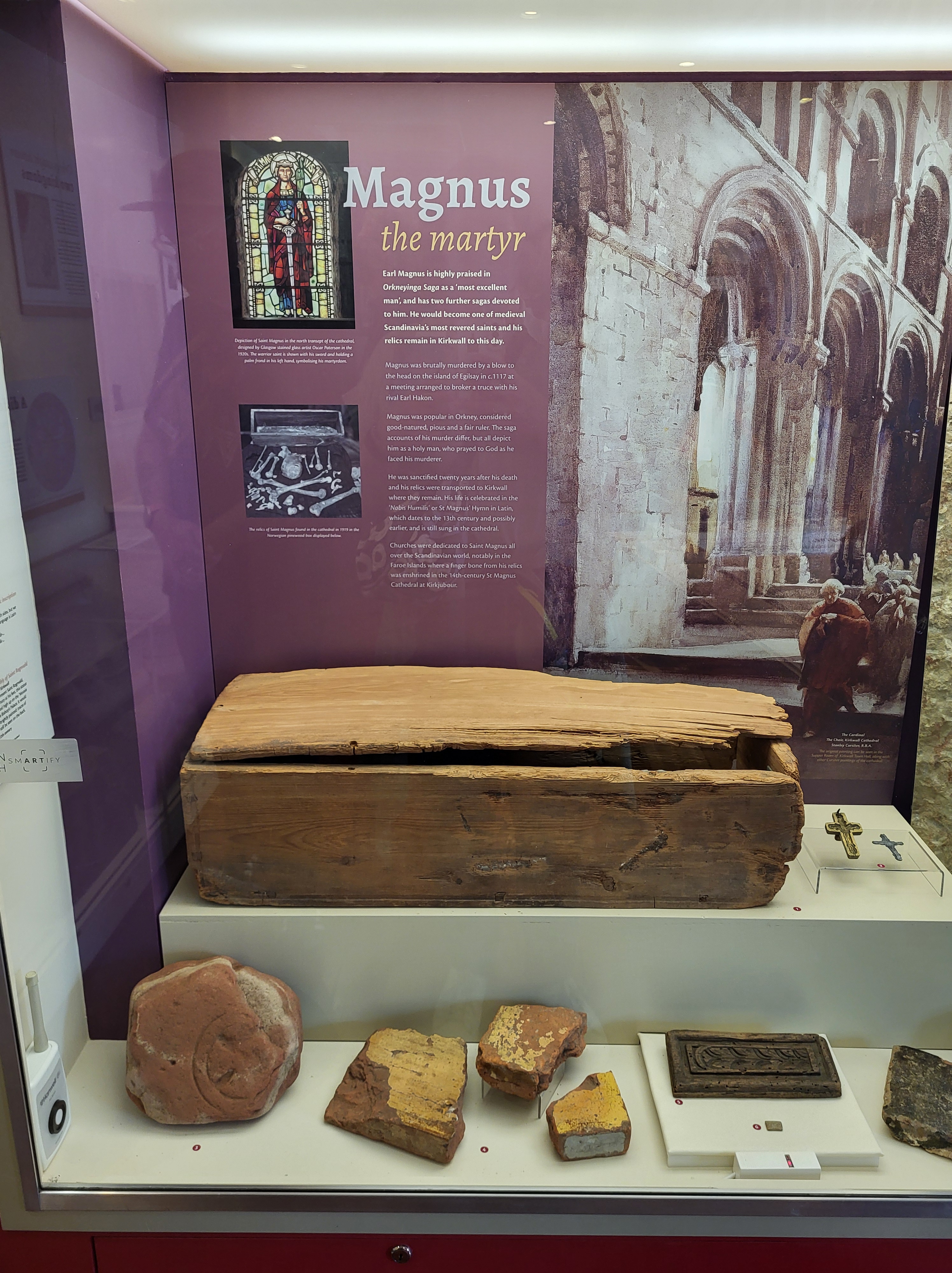
I’ve got a variety of mortuary archaeology related photos below to finish off this summary of our trip! They are all associated with the St. Magnus Cathedral. The cathedral was constructed in the 12th century when the Norse had control of the Orkney and Shetland Islands, and was named after Magnus Erlandsson, Earl of Orkney, who was ultimately killed by his cousin, and was later sanctified, becoming St. Magnus after death. During a period of restoration work in the cathedral in 1919, a wood box (pictured below), was discovered hidden inside one of the stone pillars, containing the relics of St. Magnus who had been moved from his original burial place when the cathedral was being constructed. The box now resides in the Orkney Museum across the street from the cathedral, but his remains are still within the pillar, marked with a cross.
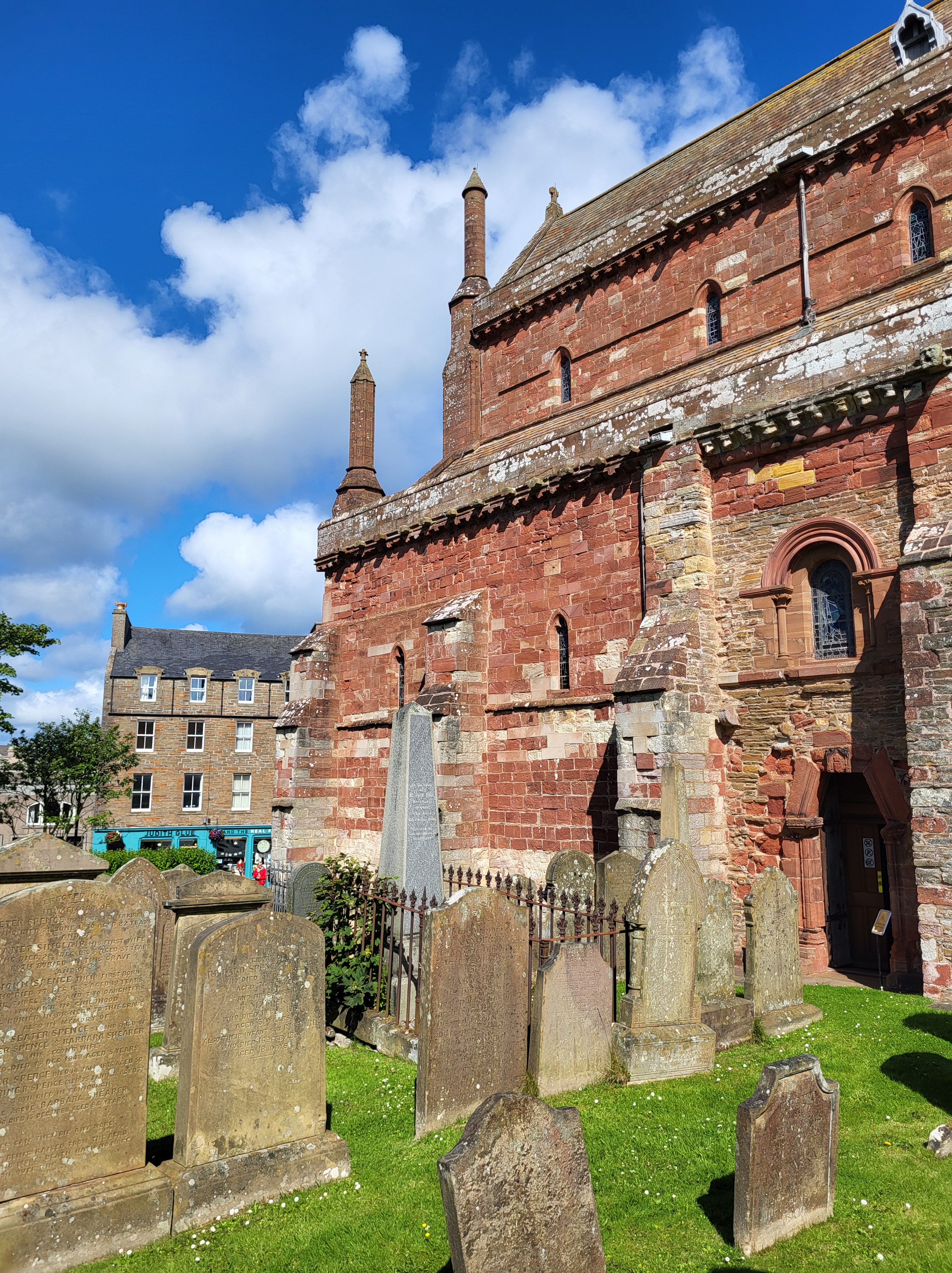

The centre photo above is me posing with a grave slab that was recovered the floor of the building, and was made in the 13th century. It’s the oldest surviving burial marker at the site, and shows a deeply incised decorative hexfoil on staff and stepped base, with a sword beside it, and the letters P and S in the top corners. I was very excited to see this marker again! The cathedral also has one known graffitied hexfoil. And finally on the left is a portion of the churchyard and the gorgeous red and yellow sandstone that makes up the cathedral walls. It really is such a striking site!
There is so much more I could talk about from this trip, from Norse burials alongside Iron Age villages, to secluded early Christian cist burials, but this feels like a good place to wrap up. Thank you for joining me on a little recap of some of the mortuary archaeology sites I have the chance to visit this summer, and I hope I’ve inspired you to do some cairn crawling of your own in the future!

 Spade & the Grave
September 28, 2024 at 6:40 am
Alice Roberts recently did a short film in Maes Howe on her Instagram, should people be interested: https://www.instagram.com/prof_alice_roberts/reel/C_OEdsoijE0/
LikeLike
September 28, 2024 at 9:58 am
That’s awesome, thanks so much!!
LikeLike
September 28, 2024 at 10:18 pm
I’m fascinated with the markers outside the church that seem to have an incredible amount of writing engraved on them. Was that much text common there?
LikeLike
September 29, 2024 at 9:43 am
Hi Teri,
Do you mean the huge ledgers and things like that? Sometimes people would pay a lot for a long inscription, it’s a good way to tell that people had money!
LikeLike
September 29, 2024 at 10:09 am
Ahh, good ol’ conspicuous consumption into the beyond. So it’s not just data, but targeted info directed to the literate class.
Thanks. I love these details. They’re so rich.
Thank you.
LikeLike