
It looks like I haven’t added to this series since 2021! I’m hoping to revive Curious Canadian Cemeteries and start writing about more sites across the country. Now that I’m on the Mainland, it will be easier to visit sites across the Maritimes, which should be very exciting.
Today’s cemetery is the Old Cemetery in Port Kirwan, on the Southern Shore of the Avalon Peninsula of Newfoundland. I might be in Nova Scotia now, but we have a lot of sites in Newfoundland to cover still, especially with my guidebook to historic cemeteries in Eastern Newfoundland in the editing process right now! To get a taste of the guidebook, lets dive into a stunning site!
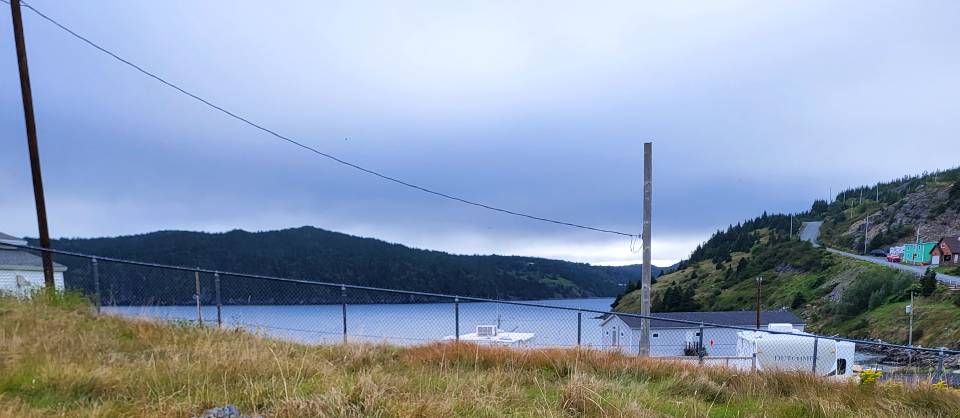
Port Kirwan’s Old Cemetery has some of my favourite gravestones in the whole province! Stones that my supervisor Dr. Barry Gaulton first told me about during my Masters research, and I’ve visited several times and made several friends look at them with me. There are gorgeous examples of locally carved stones along with some interesting iconography. Like many outports in the province, there are records of seasonal fishers in Fermeuse Harbour since at least the 18th century, and possibly as early at the 16th century by seasonal Portuguese fishers. The town was renamed in 1960 after the Reverend Mother Mary Bernard Kirwan, who founded a convent in the cove in 1853 (Poole and Cuff 1993:396).
You can reach the town by road, or by hiking along the East Coast Trail. Might I recommend the Spurwink Path? Hiking the entire length is very challenging, but if you visit Port Kirwan first (and the burial ground) you can reach the famous Berry Head Sea Arch without the hardest part of the trail!
Let me introduce you to my favourite gravestones at the site:
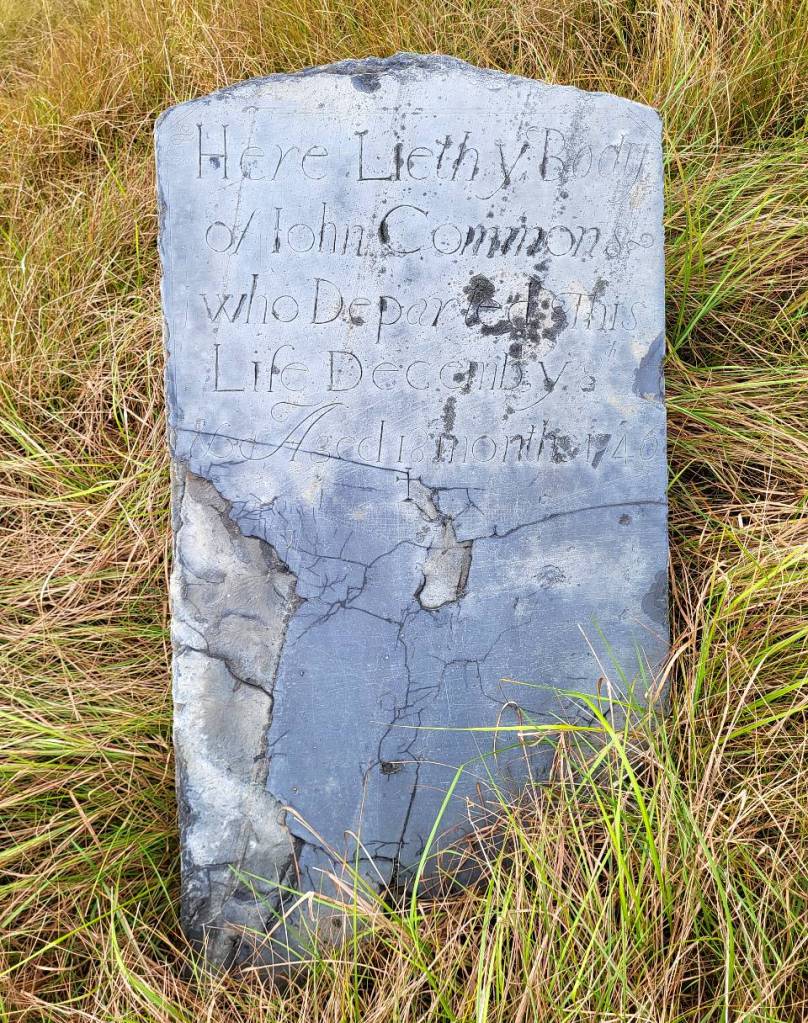
The oldest gravestone at the site belongs to John Commons, who died in 1749. It was carved locally out of locally sourced slate, something that wasn’t happening a lot in the 18th century. People tended to favour imported gravestones during this period! We unfortunately don’t know the carver’s name, but the slate has held up well and the text is still crisp and readable, with a fine decorative border below the inscription. It reads:
“~Here Lieth ye Body
Of John Commons~
Who Departed This
Life Decembr ye 8th
& Aged 18 month 1746″
The face of John’s gravestone is cracking and delicate, so if you do visit him, please refrain from touching the stone! It has lost some pieces since I first visited in 2015/16 from just weathering.
Another locally carved gravestone with particularly cool iconography is also found at this site! It’s the gravestone of Elizabeth and Thomas Brother, erected in their memory by her parents Michael and Elizabeth Brother. Elizabeth died at age 1 in 1804, and Thomas at 9 months in 1808. They were share a gravestone, which is decorated with an IHS in a cross. The IHS is most commonly seen on Catholic graves, and is the first three letters of Jesus in Greek, ΙΗΣΟΥΣ. Considering the shape of the stone, the epitaph beginning with ‘Erected by…’, and the IHS, I suspect that this was an Irish planter family on the Southern Shore, a region of the island where many Irish families settled in the 18th and 19th centuries.
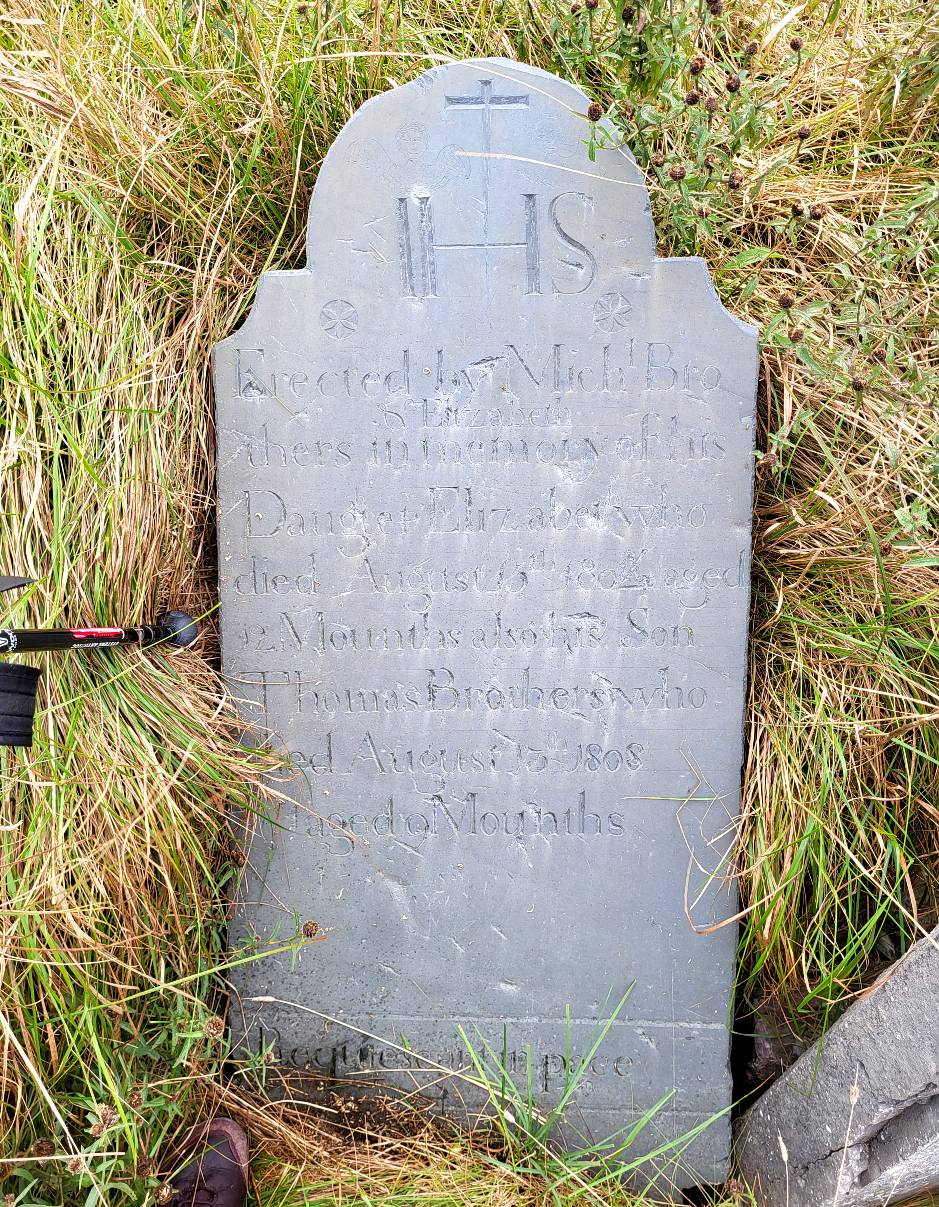
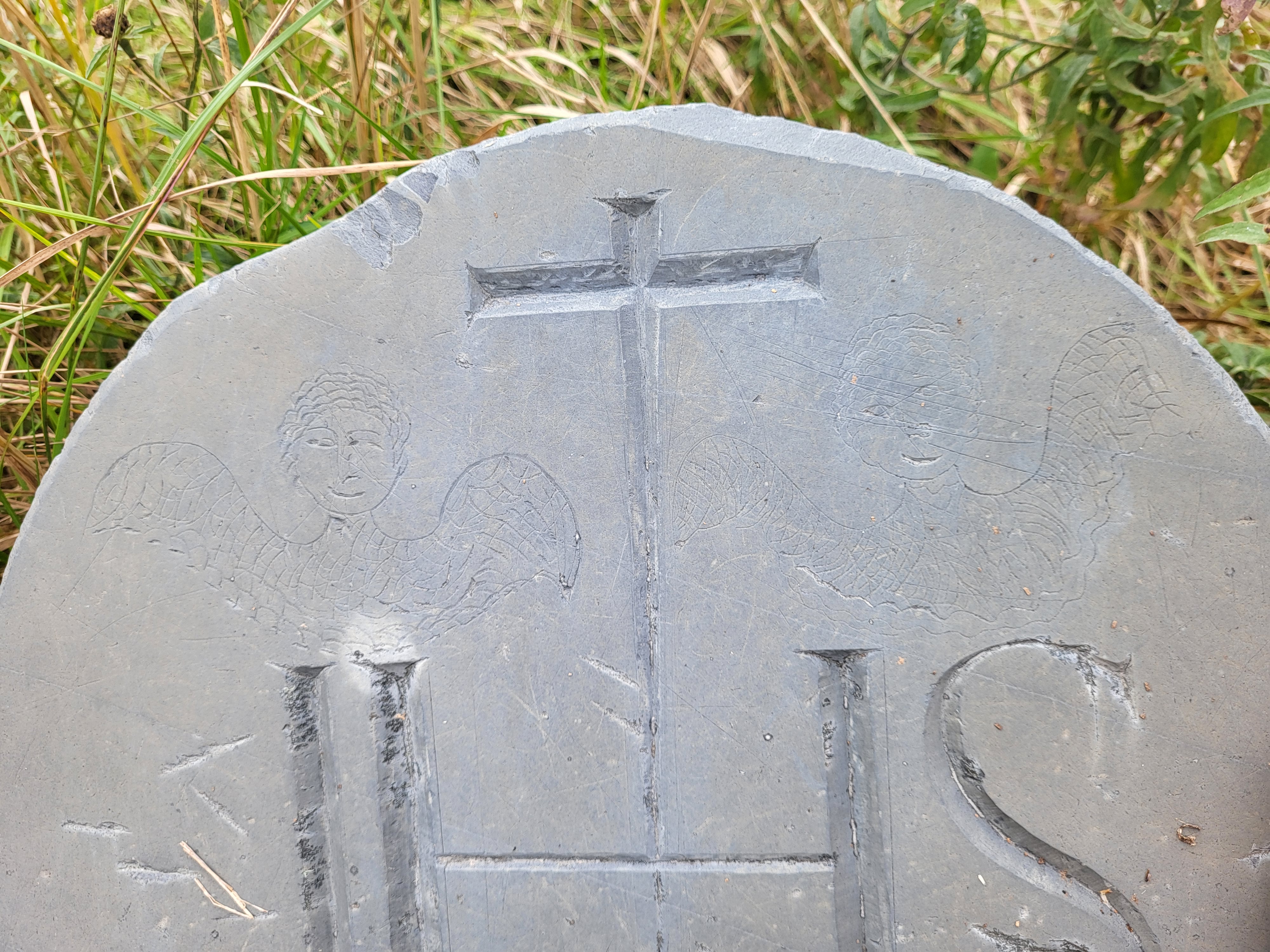
You can see some really interesting details on the lunette of the stone. There is the incised cross that crossed the bar of the H in the IHS, but if you get really close, you will see two cherubs, also called soul effigies! They almost look like they were added afterwards, because they are carved so faintly into the stone. Below the IHS are two hexfoils, or six-pointed rosettes, which are carved more deeply into the stone. You can read more about this in my book, in case you are interested! They are used as protective symbols, and this stone is one of a couple known examples of them on a gravestone in Newfoundland and Labrador. The concave finials (sort of the shoulders) of the gravestone is a common Irish style of gravestone! This gravestone is gorgeous!
There are so many other amazing gravestones at this burial ground, it is definitely a stop worth making if you are exploring the southern shore. Keep an eye out for my upcoming Graveyard Guide to Eastern Newfoundland, if you are interested in learning more about this and other historic burial grounds throughout the province!
References
Lacy, Robyn S. 2024. Daisy Wheel, Hexfoil, Hexafoil, Rosette: Protective Marks in Gravestone Art. Berghahn Books: New York.
Poole, Cyril F. and Robert Cuff. 1993. Encyclopedia of Newfoundland and Labrador, Volume 4. Harry Cuff Publications, Ltd.: St. John’s, NL.

 Spade & the Grave