
It has been a while since we’ve gotten to update the Dead House Database (click here), but we have an exciting addition to make! My internet friend and journalist, Warren Schlote, messaged me recently with a drawing of an octagonal dead house posted to instagram by the ‘History Hound’ Richard MacLeod of Newmarket, Ontario. This drawing, done by his grandfather George W. Luesby Sr. (who ran a memorial making business), shows the dead house located in the Newmarket Cemetery, north of Toronto. In this post, we’ll discuss this site and the architect who designed the structure.


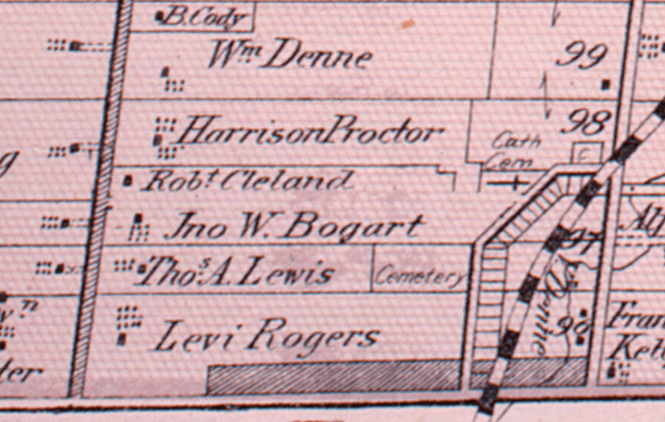
The Newmarket Protestant Cemetery is located on the eastern end of Lot 97 Con 1 E of Yonge Street, in Gwillimbury East Township, York County, Ontario. When I worked with heritage properties in Ontario I was typically not around Toronto or Yonge Street, so I was unfamiliar with the Con 1 E/W of the street designations, so that was very interesting to see! You can see on the maps below, from 1860 and 1880, that the Lot/Con was owned by Thomas A. Lewis since at least 1860, with a portion of his land sold to the town for the construction of the cemetery, which is labeled on the 1880 map. You can also see the Catholic cemetery slightly to the north, which is still there today!

MacLeod writes that the town began looking for land for the community’s public cemetery in 1867, but the property owned by Mr. Lewis was not purchased until 1869 (2019a), with the last of the sale going through several years later in 1872. The property was 12 acres, and was laid out with carriageways and plots prior to being open to the public, with 250 native trees being transplanted to the cemetery from local forests (MacLeod 2019). The site had a permanent on-site caretaker as well!
The dead house, built in the octagonal style that was popular through the 19th and into the 20th century in Ontario, was constructed between 1870-71, and so would have been completed and ready for use upon the opening of the Newmarket Cemetery. According to the sketch by Luesby above (and in the MacLeod 2019a article, see References below), the structure was built in the same Gothic Revival style as most of the other examples we’ve seen, with false windows on either side of pointed arch doorway with brick voussior above, and a decorative cupola on the roof. It was designed by local architect John T. Stokes, and was demolished between 1936-1940, according to the Luesby sketch and the Biographical Dictionary of Architects in Canada (Hill n.d.).
Stokes was born in Portsmouth, England, and moved to Canada in 1849. He worked as a postmaster, school inspector, and clerk-treasurer for East-Gwillimbury Township, before beginning to work as an architect (Hill n.d.). He is responsible for a number of significant structures in the area, including the Mansion House Hotel in Uxbridge, ON, numerous churches and private residences, public schools in Newmarket and Bolton, Ontario, and the dead house and caretaker’s residence for the Newmarket Cemetery. A complete list of properties attributed to Stokes is available on the Biographical Dictionary of Architects in Canada, linked below (Hall, n.d.). He favoured the Gothic Revival style, which is evident in the design of the dead house and caretaker’s residence, as well as being a skilled painter (Hall n.d.; MacLeod 2019b).
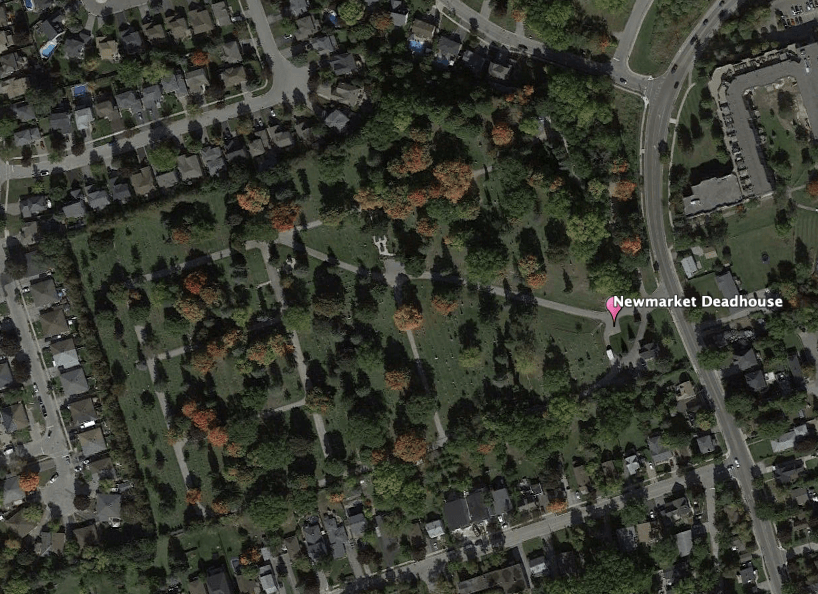
Unfortunately, there are not many good, clear photos of the dead house itself because it was torn down between 1936-1940. This is likely due to machinery becoming more widely available that could dig graves in the winter. Today, a chapel stands in the area where the dead house once stood, near the entrance to the cemetery. The Newmarket Dead house is the 4th octagonal dead house identified directly off of Yonge Street. As we’ve discussed before on this blog, the earliest of these structures is the St. Michael’s dead house in Toronto, which was built in 1855, which likely provided some influence for the other buildings. There are five other dead houses in the general area north of Toronto to Lake Simcoe, and two octagonal dead houses down near Lake Erie.
And that’s it! As always, thank you for reading, and if you know of any other dead houses in Canada, octagonal or not, please send me a message so I can add it to the database!
References
MacLeod, Richard. 2019a. Remember this? Take a peaceful stroll through Newmarket’s first cemetery. Newmarket Today, May 4, 2019. Online article: https://www.newmarkettoday.ca/local-news/remember-this-take-a-peaceful-stroll-through-newmarkets-first-cemetery-1427666.
MacLeod, Richard. 2019b. Architect John Stokes helped shape face of early Newmarket. Newmarket Today, August 17, 2019. Online article: https://www.newmarkettoday.ca/remember-this/architect-john-stokes-helped-shape-face-of-early-newmarket-1644003.
Hill, Robert G. n.d. Stokes, John Thomas. Biographical Dictionary of Architects in Canada, 1800-1950. Online database: http://dictionaryofarchitectsincanada.org/node/486.

 Spade & the Grave